A pellet grill for beginners is a wood-pellet-fueled cooker whose controller and hopper do most of the fire-tending for you — you pick a temperature, and an auger and fan hold it there while you focus on the food instead of the flames. It’s the gentlest on-ramp into real wood-fired barbecue that still lets you smoke a brisket or grill a weeknight dinner on the same machine.
This guide assumes you’ve already decided on pellets — if you’re still weighing pellet against electric, propane or charcoal for your very first smoker, our best smokers for beginners guide compares fuel types head-to-head. Here, we answer a narrower question: which pellet grill, specifically, will forgive your rookie mistakes, and what will your first month actually look like? We’re a research-led site, not a testing lab, so this guide combines manufacturer specifications, reputable BBQ and food-media coverage (SmokedBBQSource, AmazingRibs, Hey Grill Hey) and a live CPSC recall screen on every model to rank 7 genuinely beginner-friendly pellet grills for 2026 — with an honest read on the learning curve, not just the spec sheet. Here’s how we choose.
Our top picks at a glance
- Easiest overall for beginners: Traeger Woodridge Pro
- Best new budget connected grill: Traeger Westwood
- Best probe-guided learning: Pit Boss 850 DX
- Most forgiving controller: recteq RT-590
- Best budget pellet grill: Z Grills 700D4E
- Best small-patio first grill: Green Mountain Grills Ledge Prime 2.0
- Best long warranty: Louisiana Grills Black Label 800
This page vs. our other pellet grill guides
Our best smokers for beginners guide is the cross-fuel decision — it helps you pick electric, pellet, propane or charcoal. Our best pellet grill & smoker combos guide is the category anchor, covering the full size and price range once you know what you want. This page sits between them: you’ve chosen pellets, and you want to know which specific grill will actually be easy to live with in your first few months of ownership — not just which one has the biggest spec sheet.
What actually makes a pellet grill easy to learn on
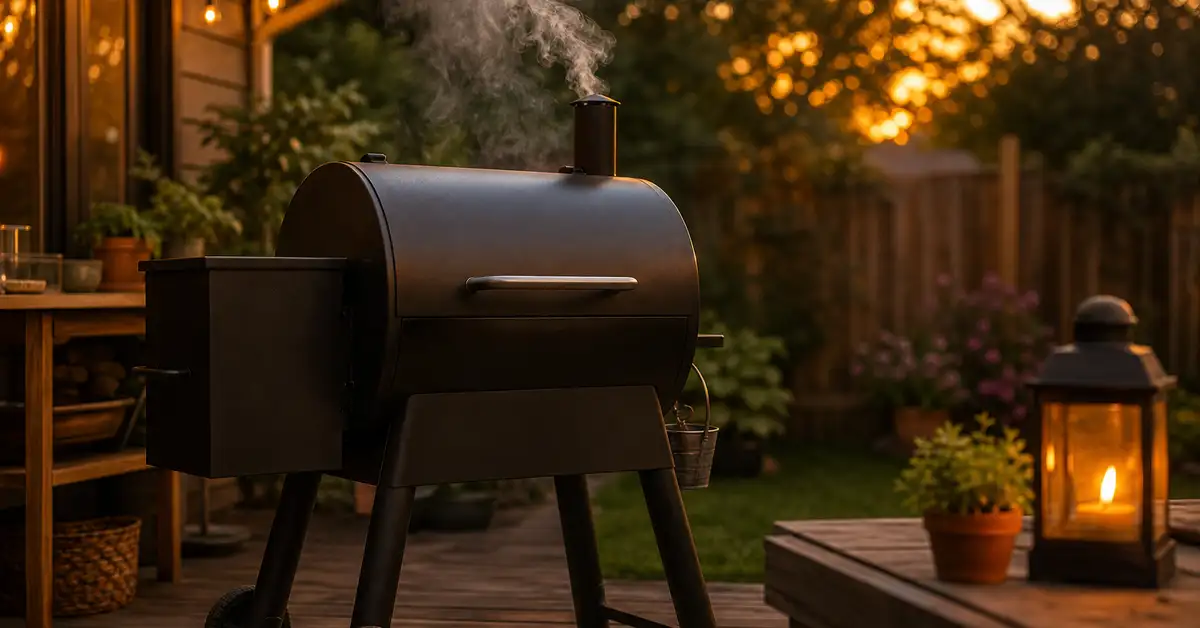
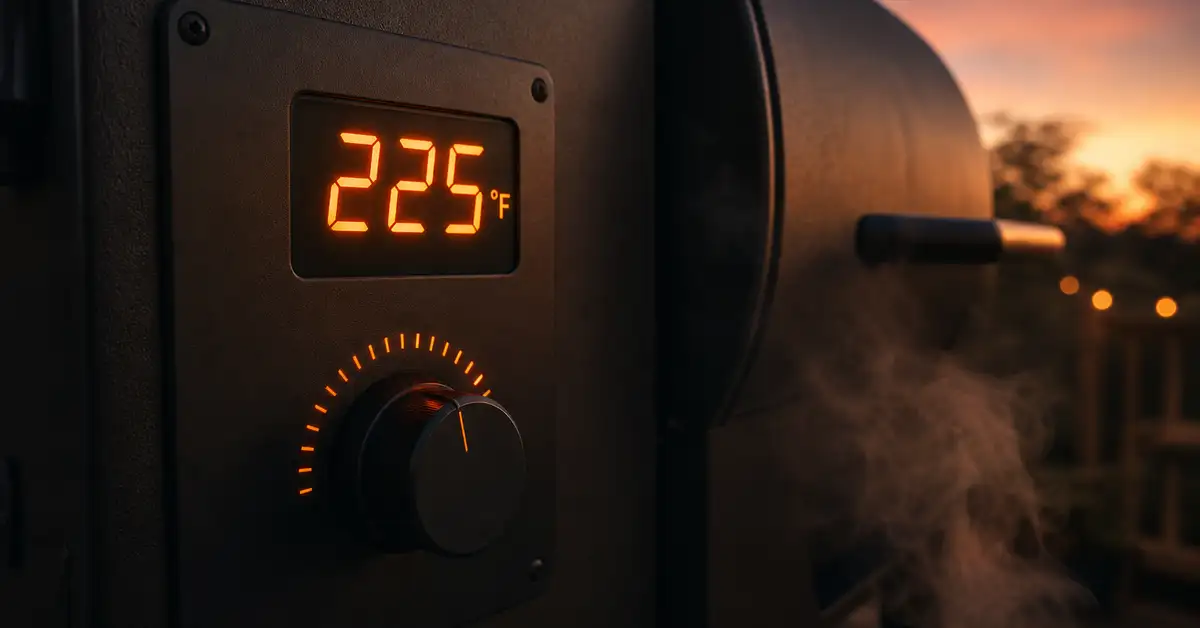
Controller type and temperature stability. This matters more than almost anything else for a beginner. Older timing-based controllers cycle the auger on and off and can swing noticeably with wind or cold; modern PID controllers continuously adjust pellet feed and fan speed, holding a set temperature within a few degrees once stabilized. A PID-controlled grill forgives the moments when you forget to check on it.
Recovery after a lid-open. Every beginner opens the lid too often at first. A well-insulated firebox and a responsive controller recover faster, so a curious peek doesn’t turn into a 45-minute temperature dip.
Hopper capacity vs. an unattended overnight cook. As a rough rule of thumb, a pellet grill burns roughly half a pound of pellets per hour on a low smoking setting and 2–2.5 lb per hour at high heat. An 18–20 lb hopper should get you through most overnight smokes; anything smaller means planning a middle-of-the-night refill.
App and probe support that actually helps. A companion app is a genuine beginner aid when it does two things well: lets you set and monitor temperature remotely, and pairs with a meat probe so you’re watching internal temperature instead of guessing. It’s a burden when it’s the only way to operate the grill — always confirm you can run the grill fully from its own control panel.
Cleanup and ash/grease management. Pellet grills generate ash in the firepot and grease in the drip system. Grills with a pull-lever ash clean-out or an accessible grease bucket turn a dreaded chore into a two-minute task — and neglecting either is the single most common way beginners create their own problems.
Warranty and parts support. A pellet grill has more moving parts than a gas grill — an auger motor, an igniter, a fan, a controller board. Longer warranties and a real support network matter more here than on simpler cookers.
Failure modes a beginner actually hits
None of these are reasons to avoid pellet grilling — they’re just things nobody tells you before your first bag of pellets. Temperature swings on a non-PID controller can make you second-guess your technique when it’s really the hardware. Pellet bridging (pellets arching in the hopper and stopping the feed) can cause a confusing mid-cook temperature drop or flame-out; keeping the hopper reasonably full and pellets dry mostly prevents it. Chasing smoke flavor trips up a lot of new pellet owners — pellet smoke is cleaner and milder than a stick burner’s, and no amount of fiddling with settings will make it taste like an offset smoker. Over-relying on the grill’s built-in probe is common and risky — built-in probes are approximate; a separate instant-read thermometer is what actually confirms doneness and food safety.
The 7 best pellet grills for beginners in 2026
Ranked for a genuine first-time pellet buyer — but every pick names who it’s really for, so jump to the one that matches your budget, space and appetite for technology.
Transparency first: This guide contains affiliate links. If we’re enrolled in an affiliate program, we may earn a commission at no extra cost to you — it never affects how we research or rank. Read our full affiliate disclosure policy.
Traeger Woodridge Pro
What it is: Traeger’s current mainstream Wi-Fi pellet grill, launched in 2025 to take over the brand’s “first real Traeger” slot.
Best for: the beginner who wants the most forgiving, best-supported first pellet grill and doesn’t mind paying a bit more for it.
Why we rate it: the WiFIRE app, Super Smoke Mode and a digital pellet-level sensor take a lot of the guesswork out of a first cook, and 970 sq in means you won’t outgrow it quickly. Traeger backs it with a 10-year limited warranty and the widest dealer/support network in the category — real reassurance for a first-timer’s inevitable question calls.
Watch-outs: independent lab testing has found its real-world ceiling closer to ~480°F than the quoted 500°F, so hard searing stays modest with no direct flame; it’s also priced above true entry-level pellet grills.
The specs: 970 sq in · 180–500°F · 24 lb hopper · WiFIRE app · 10-yr warranty · $$$
Traeger Westwood
What it is: Traeger’s newest, most affordable WiFIRE-connected pellet grill — launched in April 2026 specifically to give first-time buyers a lower-priced way into the brand’s app ecosystem.
Best for: beginners who want genuine Traeger app support and brand backing without paying Woodridge Pro money.
Why we rate it: a simplified digital controller keeps day-to-day operation uncomplicated, while WiFIRE and Bluetooth connectivity, a wired meat probe and P.A.L. accessory-rail compatibility give a new owner real room to learn. Being brand new for 2026, it also reflects Traeger’s latest grease-management and reliability updates.
Watch-outs: the 180–450°F range tops out lower than most rivals here, so it’s built for smoking and grilling rather than hard searing; it carries Traeger’s 7-Year Limited Warranty (the coverage tier Traeger applies to Westwood, Ironwood Gen 1, Timberline Gen 1 and Pro Gen 2 grills), confirmed directly on Traeger’s own product page. A larger Westwood XL (823 sq in) is also available if 653 sq in feels tight.
The specs: 653 sq in (823 sq in on the XL) · 180–450°F · 18 lb hopper · WiFIRE + Bluetooth · 7-yr limited warranty · $$
Pit Boss 850 DX
What it is: a Lowe’s-exclusive pellet grill from Pit Boss’s value-focused DX Series, built around a genuine PID controller.
Best for: beginners who want a probe to do some of the thinking for them, at a price well under most PID-equipped rivals.
Why we rate it: a PID controller with Wi-Fi and Bluetooth holds temperature more tightly than the non-PID controllers common at this price, and a probe-triggered Keep Warm mode automatically drops the grill to a holding temperature once your meat hits its target — a genuinely useful safety net if you’re not around to pull food the moment it’s done. 840 sq in and a 21 lb hopper leave plenty of room to grow.
Watch-outs: as with other Pit Boss pellet grills, a private law firm has an open (non-CPSC) investigation into fire-risk complaints on some models; we found no active CPSC recall specifically for the 850 DX. It’s a Lowe’s-exclusive, so availability depends on your local store or their site.
The specs: 840 sq in · 180–500°F, 5° increments · 21 lb hopper · PID + Wi-Fi/Bluetooth · 5-yr warranty · $
recteq RT-590
What it is: a stocky, well-built mid-size pellet grill with a PID controller reviewers describe as “almost robotic” in its consistency.
Best for: beginners who’d rather spend a bit more up front on a “buy-once” grill than fight an unpredictable controller while they’re still learning.
Why we rate it: once it settles at a target temperature, independent comparisons report swings of no more than about 5°F — genuinely reassuring on a long, unattended overnight cook. A 30 lb hopper and a 4-year warranty plus widely praised customer service round out a grill built to be your last first-grill purchase.
Watch-outs: it costs more than entry-level pellet grills, and at 590 sq in plus its weight, it’s built for a fixed spot rather than moving around.
The specs: 590 sq in · PID, ~5°F swing · 30 lb hopper · 4-yr warranty · $$$
Z Grills 700D4E
What it is: the value benchmark of the category — a lot of cooking area and a modern PID controller at a genuinely low price.
Best for: beginners on a tight budget who still want app monitoring and a controller that won’t fight them while they learn.
Why we rate it: 697 sq in, the Z-Ultra PID 3.1 controller (holds within roughly 5°F) with Wi-Fi app control, double-wall insulation and two meat probes — a lot of the same reassurance as pricier grills, at the lowest cost of entry here. A full hopper runs roughly 28 hours.
Watch-outs: tops out around 450–500°F (modest sear), and the brand’s support network is thinner than Traeger’s or Weber’s; some owners mention minor fit-and-finish quirks.
The specs: 697 sq in · Z-Ultra PID 3.1 · 28 lb hopper · Wi-Fi · dual-wall · 2 probes · $
Green Mountain Grills Ledge Prime 2.0
What it is: GMG’s current mid-size Wi-Fi pellet grill — the model formerly sold as the Daniel Boone Prime Plus, renamed Ledge Prime and now updated to the 2.0 generation.
Best for: smaller patios that still want precise app control and enough clearance for a whole chicken or a small turkey.
Why we rate it: a wide 150–550°F range in 5° steps, GMG’s well-regarded Smart Control app, and a tall 13.5″ lid that fits more than the footprint suggests. A 20 lb hopper is a genuine step up from the original Prime’s 18 lb.
Watch-outs: 530 sq in is modest next to similarly priced full-size rivals, and there’s no dedicated high-heat sear mode; some retailers still list the older 458 sq in Prime specs, so confirm you’re looking at the current 2.0 generation before buying.
The specs: 530 sq in · 150–550°F · 20 lb hopper · Wi-Fi · 13.5″ lid clearance · 3-yr warranty · $$
Louisiana Grills Black Label 800
What it is: Louisiana Grills’ mainstream pellet grill, reviewed as a solid, no-drama performer for both grilling and smoking.
Best for: beginners who value a long safety net over brand-name flash — if something breaks, this is the most reassuring warranty in this guide.
Why we rate it: a PID-style Wi-Fi/Bluetooth controller, a SearTECH direct-flame lever for real high-heat searing, and 809 sq in across two racks cover most beginner needs. Louisiana Grills backs the Black Label series with a 5-year warranty on steel and electrical parts — longer than most rivals here.
Watch-outs: connectivity and app polish are less emphasized than on Traeger or Camp Chef, so treat this as a solidly built, no-frills grill rather than a tech showcase; some listings are online-only through specific retailers.
The specs: 809 sq in · 180–600°F · 18 lb hopper · Wi-Fi/Bluetooth, PID-style · 5-yr warranty · $$
Beginner pellet grills compared
Prices move constantly, so we show qualitative price bands ($ = most affordable to $$$$ = most premium) rather than figures that go stale — tap through to check the current price yourself.
| Model | Best for | Cook area | Controller | Hopper | Price |
|---|---|---|---|---|---|
| Traeger Woodridge Pro | Easiest overall | 970 sq in | WiFIRE | 24 lb | $$$ |
| Traeger Westwood | New budget connected | 653 sq in | WiFIRE | 18 lb | $$ |
| Pit Boss 850 DX | Probe-guided learning | 840 sq in | PID + Wi-Fi | 21 lb | $ |
| recteq RT-590 | Most forgiving controller | 590 sq in | PID | 30 lb | $$$ |
| Z Grills 700D4E | Best budget | 697 sq in | PID + Wi-Fi | 28 lb | $ |
| GMG Ledge Prime 2.0 | Small-patio | 530 sq in | Wi-Fi | 20 lb | $$ |
| Louisiana Grills Black Label 800 | Longest warranty | 809 sq in | PID-style, Wi-Fi | 18 lb | $$ |
Specs are drawn from manufacturer materials and reputable editorial sources; always confirm current details with the manufacturer before buying.
Your first three cooks
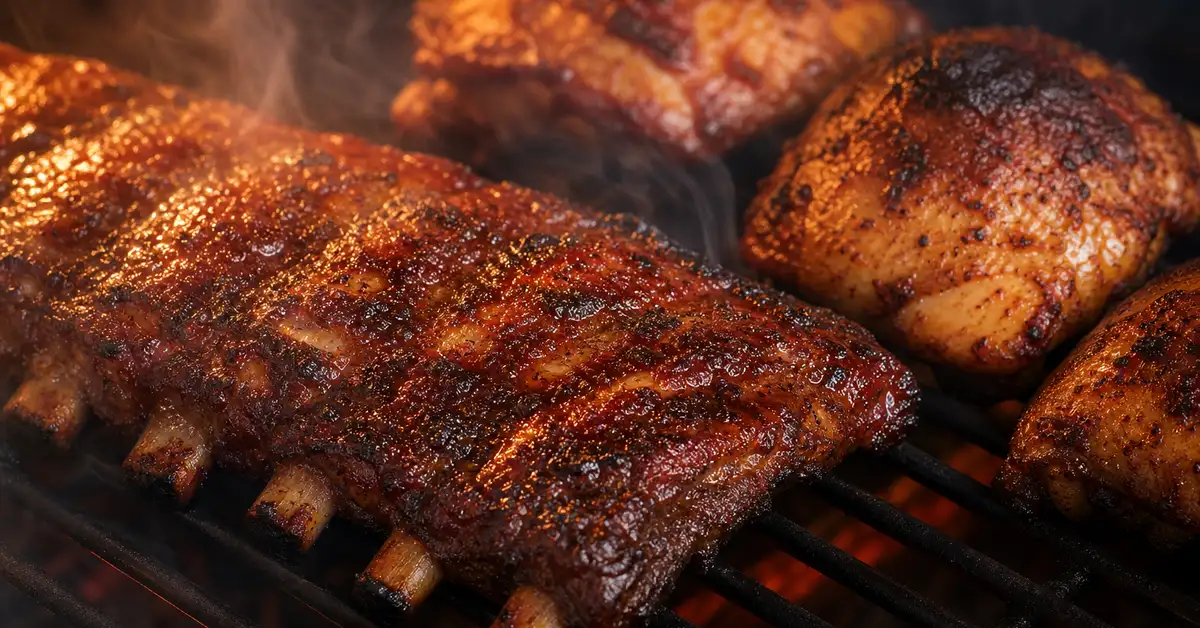
Whatever you buy, start with forgiving cuts before you tackle anything with a reputation. Chicken thighs are cheap, fast (about an hour at 250°F) and hard to ruin — a good first test of holding a steady temperature. Pork shoulder is next: it’s genuinely forgiving of small swings in time and temperature, and our how to smoke a pork butt guide walks through the whole cook. Baby back ribs round out the trio — a manageable size with a clear visual doneness cue (the meat pulls back from the bone). Once those three go well, brisket is the classic next challenge; see our how long to smoke a brisket guide when you’re ready for it — it’s a longer, less forgiving cook that’s worth saving until you trust your grill’s temperature stability. Before any of these, our how to use a pellet grill guide walks through the startup, preheat and shutdown steps every first cook needs.
What beginners regret buying
A few patterns show up again and again in owner feedback. Too small a grill: it’s tempting to save money on cooking area, but a grill that’s cramped for two rib racks gets frustrating fast — size up one notch from what you think you need. Skipping the ash clean-out check: some budget grills require a full vacuum-out after every cook; if that sounds like a chore you’ll avoid, prioritize a pull-lever ash system. Trusting the built-in probe alone: built-in temperature probes are approximate at best — pair any grill with a genuinely accurate instant-read thermometer. Buying on app features alone: a slick app is a nice-to-have, not a substitute for a stable controller — the grills above earn their spots on temperature stability first, connectivity second.
Keeping your first pellet grill running well
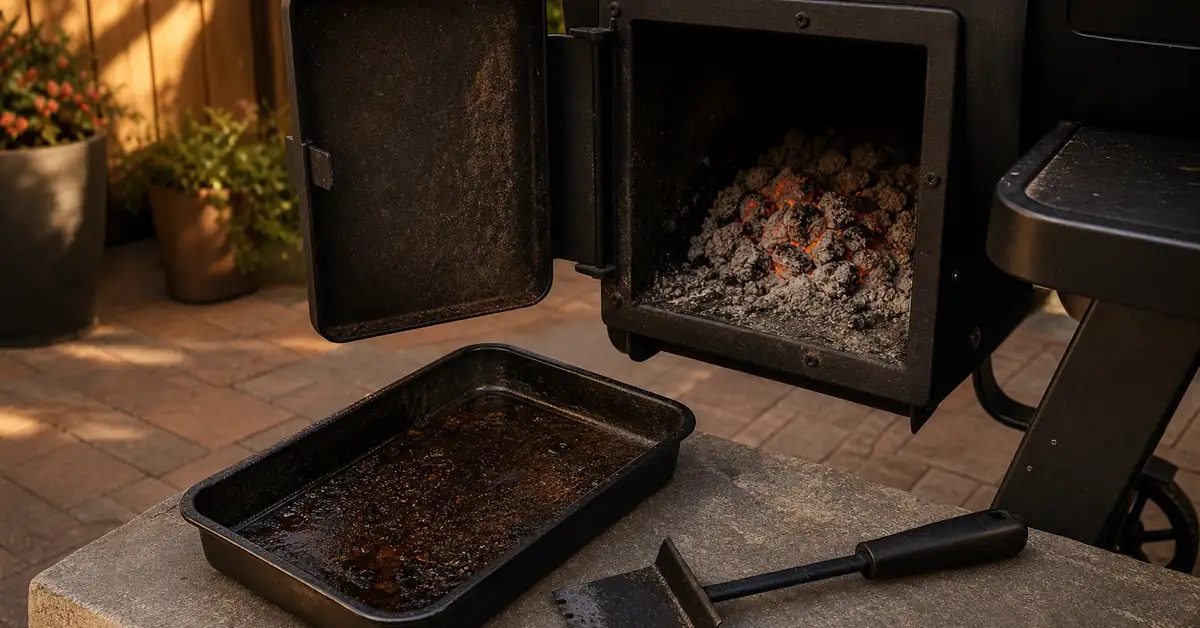
Store pellets somewhere bone-dry — damp pellets swell, jam augers and produce more ash. Empty the grease bucket and scrape the drip tray every few cooks, and vacuum or clean out the firepot on whatever schedule your model calls for; neglecting this is the single biggest cause of avoidable pellet-grill headaches. Always let a full shutdown cycle finish before covering or storing the grill, and never run any fuel-burning grill in a garage, tent or other enclosed space — pellet grills, like any fuel-burning appliance, can build up dangerous carbon monoxide indoors. If your grates are bare cast iron rather than porcelain-coated, our how to season a grill guide covers the oiling routine that keeps them rust-free. A properly fitted grill cover is cheap insurance against rust and weather once you’re done cooking for the day.
Frequently asked questions
Are pellet grills good for beginners?
Yes, for consistency. A pellet grill’s controller and fan hold a set temperature much like an oven, so you can focus on the food instead of tending a fire. The honest caveats: pellets cost more than charcoal over time, the grill needs steady power, and the smoke is milder than a traditional offset smoker’s. For most first-time buyers, that trade-off is worth it.
How long does the first cook take?
It depends on what you cook, not the grill. Chicken thighs run about an hour at 250°F; a pork shoulder typically takes 8–12 hours at 225–250°F depending on size; baby back ribs run 4–6 hours. Budget extra time beyond any recipe estimate for your first cook — you’ll be checking temperatures more often while you learn how your specific grill behaves.
Pellet grill vs. electric smoker for a first-timer?
Electric is slightly more set-and-forget and usually cheaper to run, but a pellet grill gives you genuine wood-fired flavor and the versatility to grill and sear as well as smoke, all on one machine. If you want real smoke flavor and plan to cook a variety of foods, pellet is worth the small step up in complexity; if pure simplicity matters most, see our best smokers for beginners guide for electric options.
How do I choose between these seven?
Start with budget and app preference. If you want the single most forgiving experience and don’t mind paying for it, the Traeger Woodridge Pro or recteq RT-590 lead the pack. On a tight budget, the Z Grills 700D4E or Traeger Westwood get you a real PID or app-connected experience for less. If a small patio or apartment-style space is the constraint, look at the GMG Ledge Prime 2.0; if a long warranty matters most to you, the Louisiana Grills Black Label 800 is the standout.
Do I need a Wi-Fi/app-connected grill as a beginner?
No — it’s a convenience, not a requirement. An app that lets you check temperature from your phone is genuinely useful for long overnight cooks, but every grill in this guide can be run entirely from its own control panel. If you’d rather keep things simple, a model without Wi-Fi removes one more thing that could go wrong while you’re learning.
What internal temperatures should I cook to?
Follow USDA/FoodSafety.gov guidance: poultry to 165°F; ground meats to 160°F; whole cuts of beef, pork, veal and lamb to at least 145°F with a 3-minute rest; fish to 145°F. Barbecue cuts like pork shoulder and ribs are usually taken higher (around 195–205°F) for tenderness. Long, low overnight cooks can linger in the 40–140°F danger zone if your grill’s temperature drops unexpectedly — a wireless probe alarm helps you catch that early. Always confirm doneness with a good instant-read thermometer rather than trusting a built-in gauge alone.
Are there any recalls to know about on these grills?
As of our 2026 research, we found no active CPSC recall on the Traeger Woodridge Pro, Traeger Westwood, Pit Boss 850 DX, recteq RT-590, Z Grills 700D4E, GMG Ledge Prime 2.0 or Louisiana Grills Black Label 800. Two things worth naming for context: Traeger’s 2018 recall covered its portable Scout and Ranger grills (a different product line, not covered here), and a separate 2023 recall covered Traeger’s Flatrock propane flat-top griddle — not a pellet grill. Some Pit Boss pellet grills are separately the subject of a private law firm’s non-CPSC fire-risk investigation; that is not a recall. Always check current recall status with the manufacturer and CPSC before buying.
Is a pellet grill safe to use for a beginner?
Yes, when operated and maintained as intended. Keep the firepot clear of ash buildup, don’t let grease pool in the drip system, let the full shutdown cycle finish before covering the grill, and store pellets dry. Never run any fuel-burning grill in a garage, tent or other enclosed space because of carbon monoxide risk. If you notice smoke coming from the hopper itself (a “backburn”), follow your manufacturer’s guidance and keep the lid closed rather than opening it.
Related guides
Still deciding on fuel type? Compare pellet against electric, propane and charcoal in best smokers for beginners. Want the full size and price range once you’ve got the basics down? See best pellet grill & smoker combos. Not sure how to actually fire one up? Our how to use a pellet grill guide covers your first cook, start to finish. Stock up on the best wood pellets for smoking, don’t cook without a good instant-read meat thermometer, and learn the basics with our how to smoke a pork butt and how long to smoke a brisket guides — plus how to clean a grill and how to season a grill once the season winds down. Shopping around the holidays? See our Black Friday pellet grill deals guide.
How we choose
We don’t run a testing lab, and we never fake “as tested.” For this guide we combined manufacturer specifications, reputable editorial coverage and a live CPSC recall screen on every model, prioritizing controller stability, hopper runtime, cleanup ease and warranty support — the things that actually determine whether a first pellet grill is forgiving or frustrating. We favor honest trade-offs over hype: qualitative price bands instead of prices that go stale, and a plain statement of who each grill is really for. Read more on our How We Choose page.
Sources
Manufacturer specifications: Traeger (Woodridge Pro, Westwood), Pit Boss (850 DX), recteq (RT-590), Z Grills (700D4E), Green Mountain Grills (Ledge Prime 2.0, formerly Daniel Boone Prime Plus), Louisiana Grills (Black Label 800). Editorial and comparative coverage: SmokedBBQSource, AmazingRibs, Hey Grill Hey, GearJunkie, Engadget, CNET. Safety and recall data: U.S. Consumer Product Safety Commission (CPSC) recall database and FoodSafety.gov. Specifications were current at the time of research (2026) and should be reconfirmed with the manufacturer before purchase.