Short answer: fill the hopper and prime the auger, run the startup cycle until smoke turns from thick white to thin blue (about 8–12 minutes total), preheat with the lid closed to your target temperature, cook to internal temperature rather than the clock, then always finish with the controller’s shutdown cycle — never by unplugging or killing power mid-cook. A pellet grill’s auger and fan do the fire-tending for you; your job is mostly patience and a good thermometer.
A pellet grill behaves differently from a stick-burner or a charcoal kettle — there’s no manual airflow to manage, but there is a startup and shutdown procedure that matters more than people expect. Here’s the honest first-cook walkthrough: how to fire it up, what the smoke should look like at each stage, how to manage a long cook, and the one shutdown habit that prevents almost every pellet-grill safety problem.
How to use a pellet grill, at a glance
Typical figures across mainstream pellet grills (Traeger, Pit Boss, Camp Chef, recteq, Z Grills). Always confirm against your specific owner’s manual — controllers vary.
| Stage | Typical time | Typical temperature |
|---|---|---|
| Auger priming | 2–7 minutes | — |
| Startup / white-smoke phase | 5–10 minutes | — |
| Smoke setting | — | ~160–225°F |
| Standard grilling | — | 350–450°F |
| Shutdown / cool-down cycle | 10–20 minutes | fan-only, auger off |
How to use a pellet grill, step by step
1. Fill the hopper and prime the auger
Fill the hopper with dry pellets, then run the priming function (usually the highest setting, or a dedicated “Prime” button) until pellets are visibly falling into the firepot — typically 2–7 minutes. Do this any time the hopper has run empty or after cleaning, not on every single cook.
2. Run the startup sequence with the lid open
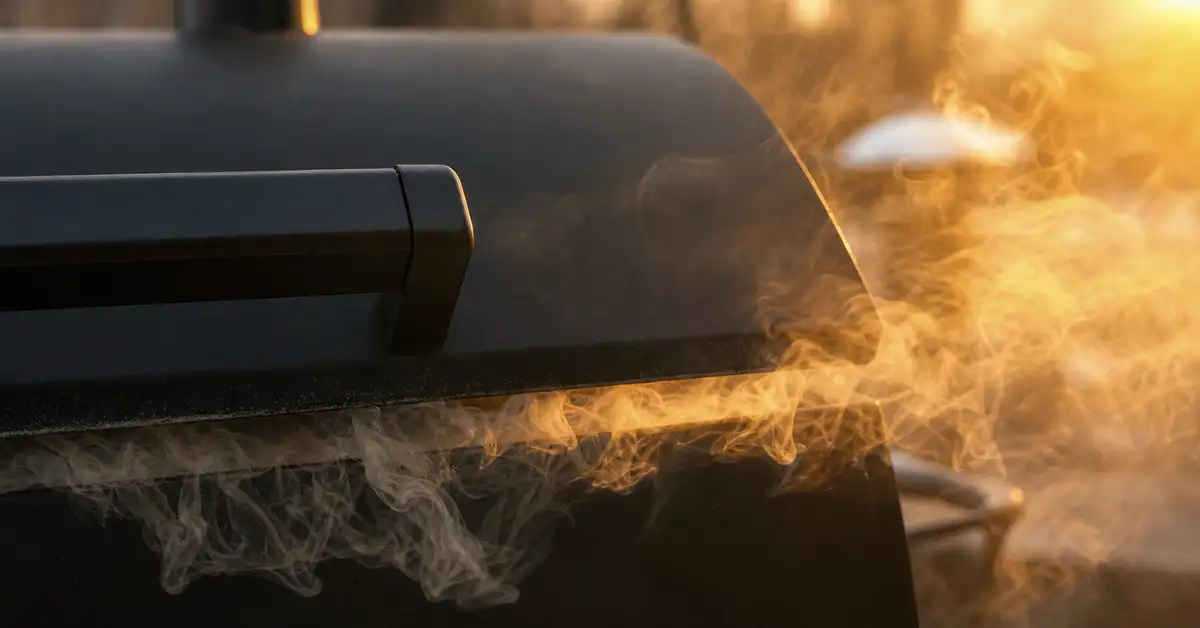
Set the controller to SMOKE (or your model’s startup setting) with the lid open for the first several minutes. Expect thick white “dirty” smoke for roughly 5–10 minutes as the igniter lights the pellets — this is normal, not a malfunction. Once the smoke thins to a light blue-gray, close the lid.
3. Preheat to your target temperature, lid closed
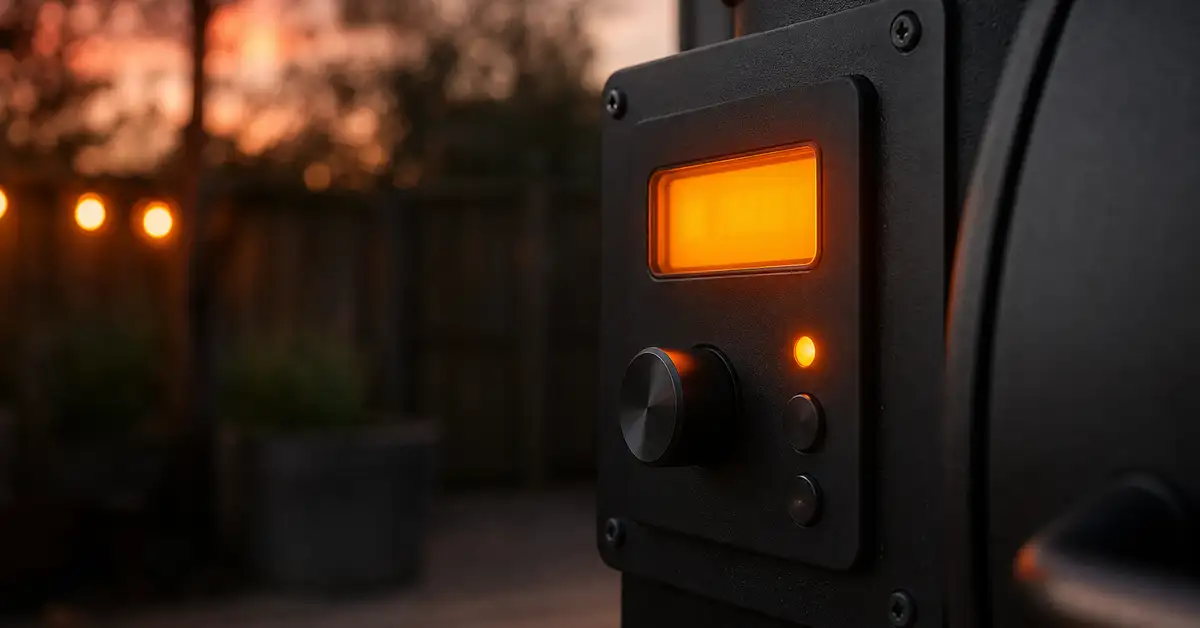
Dial in your target temperature and let the controller settle — typically another 10–20 minutes depending on the target and the weather. A PID controller holds much tighter than a basic dial-in digital controller, but both need this settling time before food goes on.
4. Understand the smoke profile before you cook
Low temperatures (roughly 160–225°F “smoke” settings) produce more visible smoke and more smoke flavor than high-heat grilling, because combustion is less complete at lower temperatures. Some controllers add a separate smoke-boost setting (Camp Chef’s Smoke Number, Pit Boss’s P-setting) that fine-tunes this independently of temperature. Pellet smoke is inherently cleaner and lighter than a stick-burner’s — that’s the trade for set-and-forget convenience, not a fault in your technique.
5. Load the food and place your probe
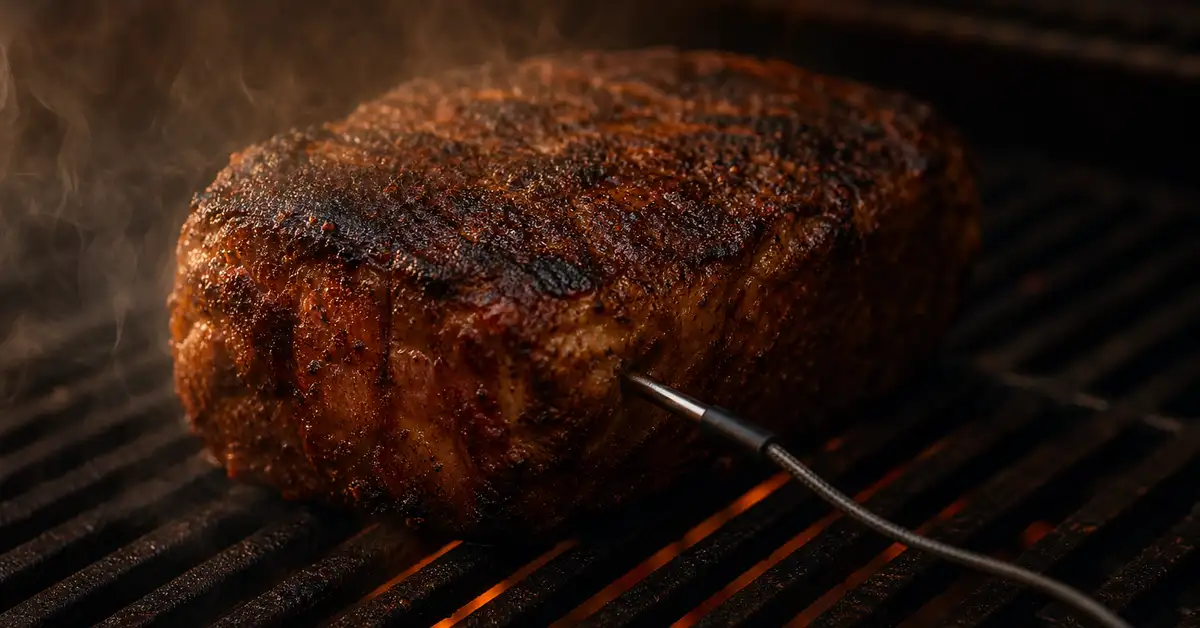
Once the grill has settled at temperature, load your food and insert a probe (built-in or a separate wireless one) into the thickest part of the cut, away from bone and fat. Close the lid promptly — every lid-open costs you recovery time, more so on a smaller or less-insulated grill.
6. Manage the cook
Resist opening the lid to check on things — a pellet grill’s whole appeal is that the controller is doing that job. Expect a temperature “stall” partway through a long low-and-slow cook (common on pork shoulder and brisket, roughly 150–170°F internal) where evaporative cooling flattens the rise for an hour or more — it’s normal, not a sign anything is wrong. Cold or windy weather will increase pellet consumption and can pull ambient temperature down; a well-insulated grill recovers faster than a single-wall one.
7. Finish to temperature, not to time
Recipe times are estimates — weather, altitude, and the individual piece of meat all shift the real cook time. Pull food at a safe, correct internal temperature confirmed with a good instant-read meat thermometer rather than a built-in probe alone, which tends to run approximate.
8. Run the full shutdown cycle — never unplug mid-cook
When you’re done, use the controller’s OFF or SHUTDOWN function rather than pulling the plug. This stops the auger from feeding new pellets while the fan keeps running for roughly 10–20 minutes to burn out what’s left in the firepot and cool things down. Skipping this step is the single biggest cause of “backburn” — pellets in the auger tube igniting and, in rare cases, carrying fire back into the hopper. Never kill power while the grill is still hot and running.
9. Clean out ash, grease and the hopper
Once fully cooled, empty the firepot’s ash and the grease tray — built-up grease is the leading cause of flare-ups, and ash buildup in the firepot is what allows a future backburn to reach the auger. Keep pellets dry between cooks; damp pellets swell, jam the auger and produce more ash. See our full how to clean a grill routine for the deeper seasonal version.
Is it safe? Fire, carbon monoxide and food-safety basics
Pellet grills combine live fire, grease and electricity, so a few habits matter every time. Carbon monoxide: use outdoors only — never in a garage, breezeway, tent or other enclosed space, even with the lid open. Grease fires: keep the grease tray and drip system emptied regularly; a full tray is the leading cause of dangerous flare-ups. Auger backburn / hopper fire: always run the full shutdown cycle (step 8) rather than unplugging; if you ever see smoke coming from the hopper itself, follow your manufacturer’s guidance and keep the lid closed rather than opening it, since starving the fire of oxygen is usually the safer response. Wet or damp pellets: can jam the auger and increase ash and smoke — store pellets in a sealed, dry container. Never leave a lit grill unattended, and keep kids and pets back from the hot exterior.
Food safety: the 40–140°F range is the danger zone — time in that range is not doneness, and a long stall during a low-and-slow cook is not itself a food-safety problem as long as the grill’s ambient temperature stays where you set it. Follow USDA/FoodSafety.gov-consistent safe internal temperatures: poultry to 165°F; ground meats to 160°F; whole cuts of beef, pork, veal and lamb to at least 145°F with a 3-minute rest; fish to 145°F. Barbecue cuts like pork shoulder and ribs are typically taken higher (195–205°F) for tenderness, not for food safety. Always confirm with a real instant-read thermometer rather than trusting a built-in probe alone.
The one thing worth getting right on your first cook
More first cooks go wrong from impatience than from any hardware problem — opening the lid too often, cooking to the clock instead of the thermometer, or killing power the moment the food comes off instead of running the shutdown cycle. Give the startup and shutdown stages their full time, and the rest of the learning curve is genuinely gentle.
Transparency first: This guide contains affiliate links. If we’re enrolled in an affiliate program, we may earn a commission at no extra cost to you — it never affects how we research or rank. Read our full affiliate disclosure policy.
Check wireless meat thermometers on Amazon →
Still choosing your first pellet grill? See our best pellet grill & smoker combos guide, or if you’re brand new to the category, best pellet grills for beginners. Stock up on the best wood pellets for smoking, and when you’re ready for a longer cook, see how long to smoke a brisket, how to smoke a pork butt or how long to smoke ribs. Our How We Choose page explains the research behind every recommendation on this site.
Frequently asked questions
How long does it take to start a pellet grill?
Priming the auger typically takes 2–7 minutes, and the initial white-smoke startup phase runs another 5–10 minutes before smoke thins and stabilizes. Budget roughly 15–30 minutes total from lighting to a settled cooking temperature, depending on your target and the weather.
What temperature is the “smoke” setting on a pellet grill?
Most pellet grills’ smoke or low-smoke settings run roughly 160–225°F, though the exact figure varies by brand — Camp Chef’s Low Smoke is nominally 160°F and High Smoke 220°F, while Pit Boss’s smoke setting commonly runs 180–210°F. Check your specific model’s manual for its exact range.
Why is my pellet grill producing thick white smoke?
Thick white smoke for the first 5–10 minutes of startup is completely normal — it’s the ignition phase before the fire fully establishes. If it persists well beyond that, or reappears mid-cook, check that your pellets are dry and that ash isn’t built up in the firepot.
Can I just unplug my pellet grill when I’m done cooking?
No — always run the controller’s shutdown or cool-down cycle first. It stops the auger from feeding more pellets while the fan burns off what’s left in the firepot, which is what prevents auger backburn and sets the grill up safely for its next start. Unplugging or killing power while it’s still hot and running is the single biggest cause of pellet-grill fire risk.
What is a “stall” and is it normal?
Yes, completely normal on long low-and-slow cooks. Around 150–170°F internal, evaporative cooling from the meat’s surface can flatten or even briefly reverse the temperature rise for an hour or more. It resolves on its own — resist the urge to crank the grill’s temperature to force through it.
Do I need to babysit a pellet grill like a charcoal fire?
No — that’s the core appeal. The auger, fan and controller hold your set temperature without manual fire-tending. You’ll still want to check in periodically (especially on your first few cooks) and always confirm doneness with a real thermometer, but you don’t need to feed or adjust a live fire by hand.
Is it safe to run a pellet grill overnight, unattended?
Most owners do run long overnight cooks, but take sensible precautions: keep the firepot and grease tray clean beforehand, use a wireless probe with a low-temperature alarm so a stall or power interruption doesn’t go unnoticed, and never run any fuel-burning grill in a garage or other enclosed space because of carbon monoxide risk.
What internal temperature should I cook different foods to?
Follow USDA/FoodSafety.gov guidance: poultry to 165°F; ground meats to 160°F; whole cuts of beef, pork, veal and lamb to at least 145°F with a 3-minute rest; fish to 145°F. Barbecue cuts like pork shoulder and ribs are typically taken to 195–205°F for tenderness, well above the food-safety minimum. See our best instant-read meat thermometers guide for a thermometer that reads accurately and fast.
Sources
Startup timing, smoke-setting temperatures and shutdown-cycle guidance verified against Traeger Support — How to Prime an Auger, Traeger Support — How to Shut Down Your Traeger Pellet Grill, Traeger Support — Smoke Coming out of Hopper, Pit Boss FAQ, Pit Boss — What Is Back Burn, Camp Chef FAQ, and BBQGuys — How to Turn Off a Pellet Grill. Fire and carbon-monoxide safety guidance from the National Fire Protection Association — Grilling Safety, with food-safety guidance from FoodSafety.gov — Safe Minimum Internal Temperatures.