Short answer: it depends on your grill’s diameter and on whether you’re cooking direct or indirect. Weber’s own owner’s guide for its 22-inch Master-Touch kettle calls for about 50 standard charcoal briquettes for a direct, high-heat cook, or 25 per side for the first hour of an indirect cook plus 8 more per side for each extra hour. An 18-inch kettle needs less (about 40 direct) and a 26-inch kettle more (about 80 direct). If you think in chimneys rather than counts, Kingsford sizes a standard chimney at about 100 briquettes: a full chimney for high heat, half for medium, a quarter for low.
There’s no single “right” amount of charcoal. The number moves with grill size, cook method, how long you’re cooking and how you spread the coals. The good news is that the grill and charcoal makers publish real starting numbers. Below we pull those together into one table, then walk through how to adjust them for your cook.
How much charcoal by grill size, at a glance
These are the starting loads Weber publishes for standard (non-Weber-brand) charcoal briquettes in its US kettle owner’s guide. Indirect figures are per side, so a two-sided indirect fire uses double the number shown.
| Grill diameter | Direct heat (quick cooks) | Indirect, first hour | Indirect, each extra hour |
|---|---|---|---|
| 18-inch kettle | 40 briquettes | 20 per side | add 7 per side |
| 22-inch kettle | 50 briquettes | 25 per side | add 8 per side |
| 26-inch kettle | 80 briquettes | 40 per side | add 9 per side |
| 37-inch kettle | 150 briquettes | 75 per side | add 22 per side |
Weber’s guide lists lower counts for its own Weber-brand briquettes (for example, 40 rather than 50 for a direct fire in a 22-inch kettle), so check which briquettes your bag holds. If your grill is a smaller portable, start below the 18-inch figure and check its manual; if it’s a barrel or another shape, use its own manual rather than a kettle chart.
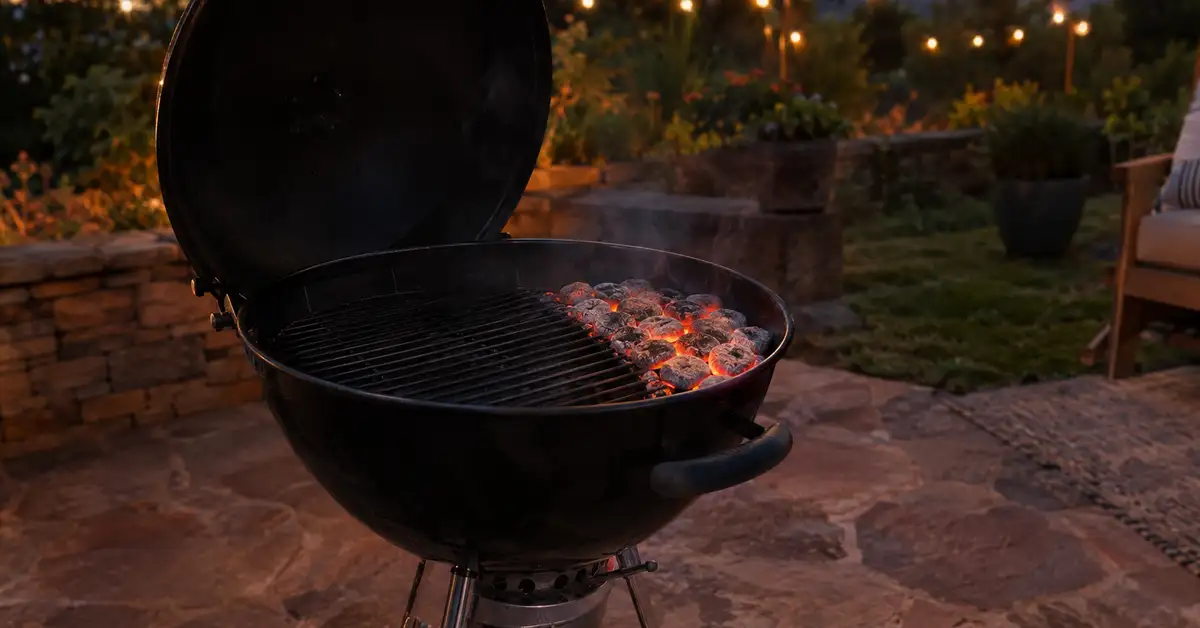
Prefer to measure by the chimney?
Kingsford’s charcoal chart is built around a standard chimney starter holding about 100 briquettes. It uses the chimney as the measuring cup:
| Heat you want | Chimney fill | About how many briquettes | About how much by weight |
|---|---|---|---|
| High (450–550°F) | 1 full chimney | ~100 | 4 lb |
| Medium (350–450°F) | ½ chimney | ~50 | 2 lb |
| Low (250–350°F) | ¼ chimney | ~25 | 1 lb |
The two charts aren’t contradictory. Weber’s starts from your grill’s diameter, while Kingsford’s starts from the heat you want. Chimneys also vary in size, so treat “a full chimney” as roughly 100 briquettes, not an exact count.
How to work out how much charcoal you need, step by step
1. Measure your grill
Measure the diameter across the top of the bowl, or check the manual. Weber’s chart covers 18-, 22-, 26- and 37-inch kettles. The diameter sets the baseline, because a bigger grate needs a bigger bed of coals to heat evenly.
2. Decide direct or indirect
Weber’s rule of thumb is a good one. Food that cooks in under about 20 minutes (burgers, steaks, chops, kabobs, fish fillets, sliced vegetables) goes over direct heat. Larger cuts that take 20 minutes or more, delicate foods, whole chickens, roasts and ribs go indirect, over a coal-free zone.
3. Count out your starting load
Use the table above. For a 22-inch kettle that’s about 50 standard briquettes for a direct fire, or 25 per side for an indirect fire’s first hour. Counting once or twice teaches you what that load looks like in your chimney, so you can eyeball it after that.
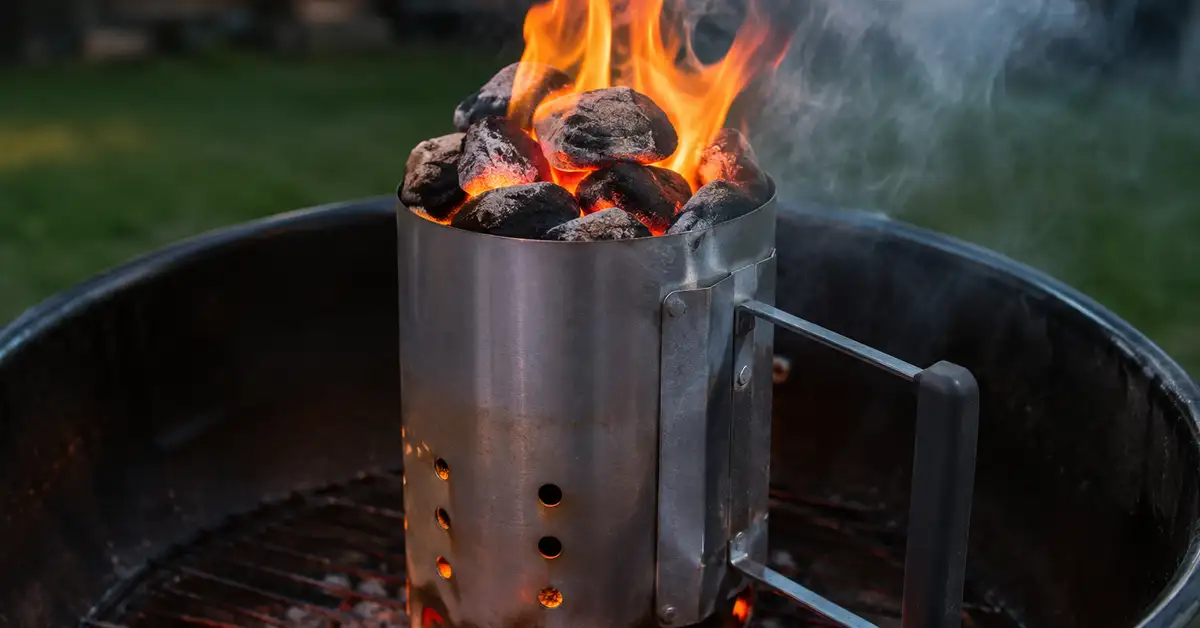
4. Light it in a chimney starter
Set the chimney on the charcoal grate, fill it with your counted briquettes, and light newspaper or lighter cubes underneath with a long match or lighter. The coals are ready when they’re covered with a coating of white or gray ash. Our how to start a charcoal grill guide covers lighting in full.
5. Arrange the coals for the cook
For direct heat, spread the lit coals evenly across the charcoal grate. It’s still smart to leave a small coal-free area as a place to move food during a flare-up. For indirect heat, bank the coals on one side (a two-zone fire) or split them onto opposite sides with the food in the middle over a drip pan. A deeper, more concentrated pile runs hotter and lasts longer than the same coals spread thin.
6. Plan your top-ups before you start
Any indirect cook that runs past an hour will need more fuel. Weber’s chart adds 7 to 9 briquettes per side for each extra hour on an 18- to 26-inch kettle, and a hinged cooking grate makes adding them easy. Unlit briquettes set against burning coals catch from them gradually. Kingsford’s snake and burn-down methods rely on the same principle, so add fresh briquettes a little before the fire starts to fade.
7. For long low-and-slow cooks, build a charcoal snake
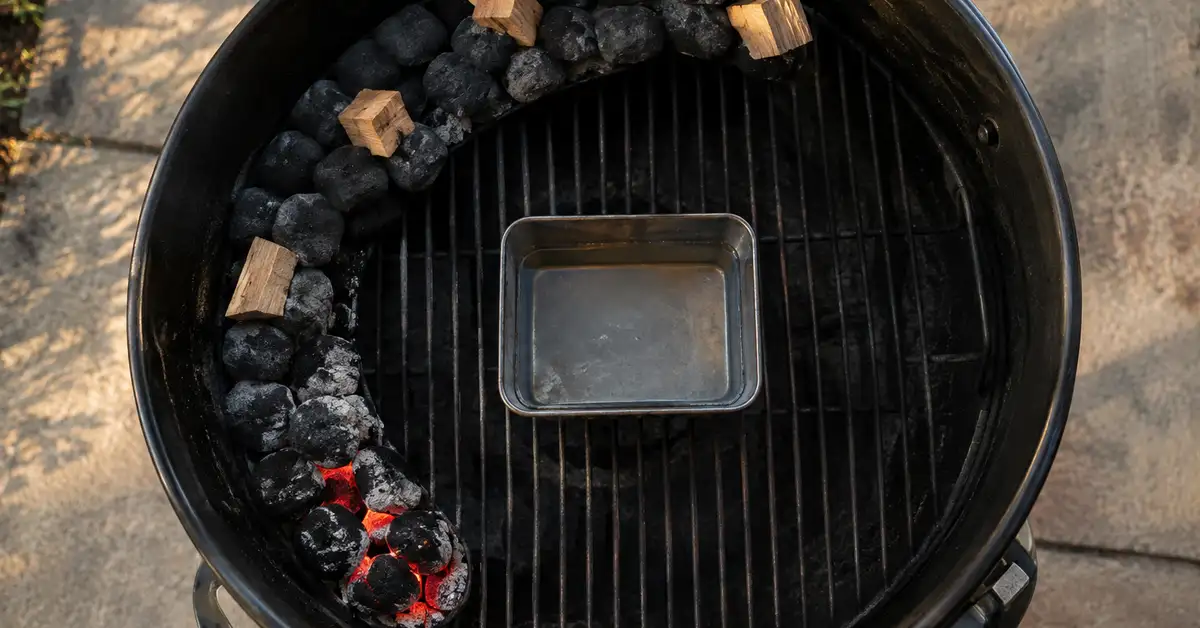
For several hours of steady low heat in a kettle, lay unlit briquettes in a curved path around the edge of the charcoal grate and light only one end. Kingsford’s version uses 100 unlit briquettes in 2 rows, three-quarters of the way around, started with 6 to 8 lit coals. Details and timings are in the next section.
8. Shut it down and save the leftovers
When you’re done, close the lid and both vents to starve the fire of oxygen. Once everything is completely cold, Kingsford says partially burned briquettes that haven’t turned to ash can stay in the grill to help start your next fire. That’s less charcoal to buy and less to throw away.
The charcoal snake: how much for a long smoke
The snake (also called the fuse method) lets a kettle hold low heat for hours because the coals light one after another down the line. Two published versions give you a starting point:
- Kingsford: 100 unlit briquettes in 2 rows, three-quarters of the way around the grill’s outer edge, with 6 to 8 lit coals piled at the head. Kingsford targets 225–250°F and says you can add more briquettes to the end of the snake if you need more time.
- Serious Eats sizes the snake to the cook, with two rows wide and two layers high: a half-ring of about 40 briquettes per layer for ribs (4 to 5 hours), about two-thirds of the way around with roughly 60 per layer for pork butt (6 to 7 hours), and a longer snake for brisket (8 to 9 hours of smoke), where you’ll likely need to add more fuel. It lights the snake with a chimney about a third full.
These are recipe examples, not guaranteed burn times. Wind, vent settings and your briquettes all change how fast the snake burns, so check your lid thermometer and add fuel to the tail end if it’s running short. For the cook itself, our guide to how long to smoke ribs covers timings and doneness.
What changes the answer
Briquettes vs. lump charcoal. Every count on this page is for briquettes, which are uniform enough to count. Lump charcoal comes in irregular pieces, so a lump count means little. Measure lump by chimney volume instead, and watch your thermometer, since it tends to light faster and burn differently. Our lump charcoal vs. briquettes guide explains the differences.
How you spread the coals. Kingsford notes that a thin layer over a large area runs cooler and fades faster, while a deeper, concentrated pile runs hotter and lasts longer. The same 50 briquettes can make two very different fires.
Lid and vents. More air means a hotter, faster burn. Weber recommends keeping the lid closed as much as possible. For lower indirect temperatures it suggests closing the vents as much as halfway, but never all the way, because shutting them completely puts the fire out.
Weather and the food itself. Weber’s grilling guide notes that wind, altitude and outside temperature all affect cooking times, and that frozen food takes longer and may need more fuel. Longer cooks mean more top-ups, so a cold, breezy evening is a good night to count out a few extra briquettes before you start. Weber also says not to grill in high winds at all.
Safety: carbon monoxide, lighter fluid and hot ash
Outdoors only, always. The U.S. Consumer Product Safety Commission warns that people die every year from carbon monoxide poisoning after burning charcoal in enclosed spaces. Never use charcoal to cook or heat inside a home, garage, tent, camper, van or other vehicle, even after the cooking is done and the coals are just smoldering.
Never add lighter fluid to lit coals. NFPA says that if you use starter fluid, use only charcoal starter fluid, and never add it, or any other flammable liquid, to coals that are already lit. Weber’s owner’s guide says the same about hot or warm charcoal. A chimney starter avoids lighter fluid entirely.
Handle the chimney like a hot pan. Light it with a long match or lighter, wear heat-resistant gloves when you pour, and remember that the chimney, the charcoal grate and the bowl all stay hot.
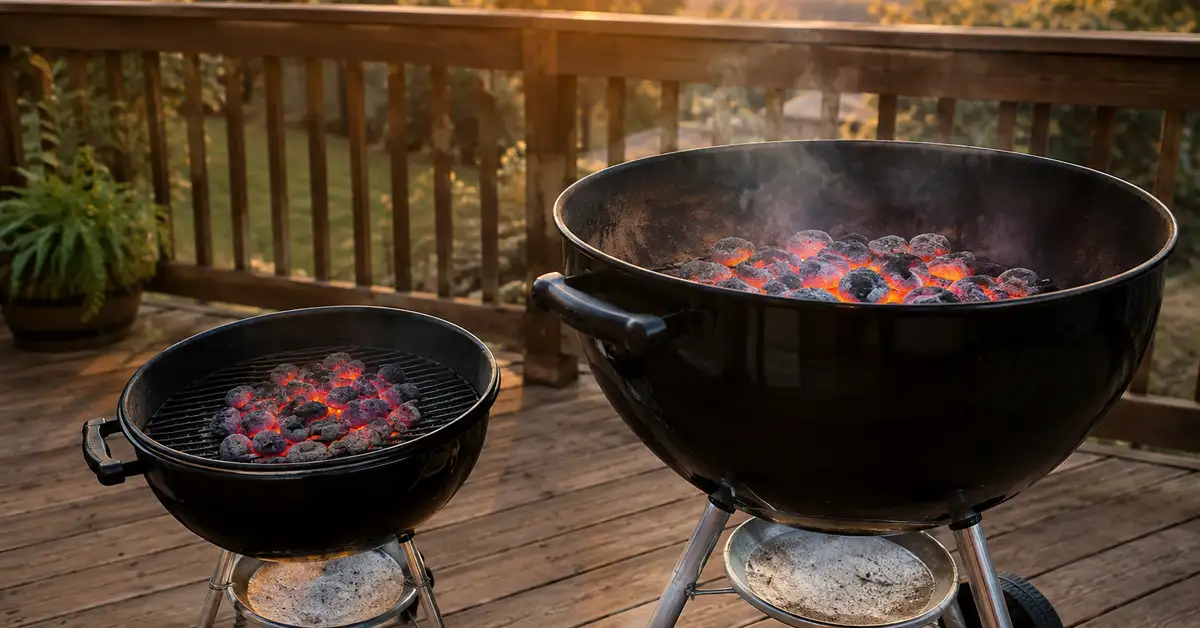
Give the grill room. NFPA advises setting the grill well away from the house and deck railings, out from under eaves and overhanging branches, and keeping children and pets at least 3 feet from the grilling area. Weber’s kettle guide adds a minimum of 2 feet from any combustible material, including wood decks and porches.
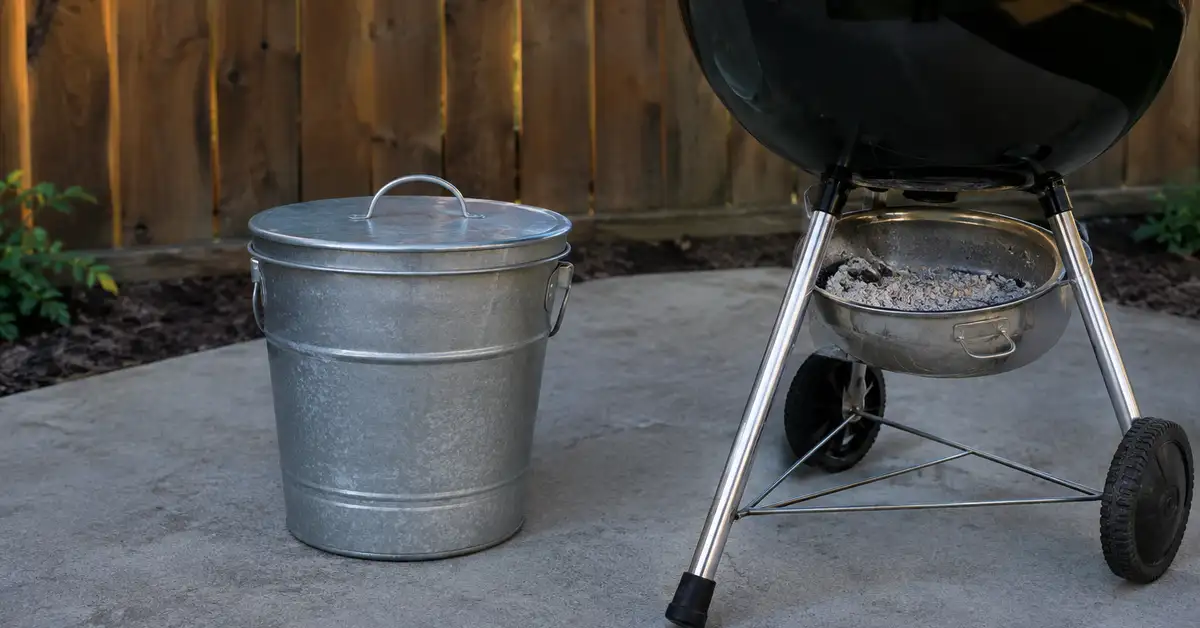
Treat ash as live until proven cold. Kingsford’s safest shutdown is to close the lid and every vent and leave the coals alone for at least 48 hours, because embers can stay hot beneath the ash and reignite. Weber says not to remove ashes until all the charcoal is fully extinguished and the grill is cool. Once it’s cold, NFPA says to empty the coals into a metal container with a tight-fitting lid, used only for coals, kept outside and away from anything that can burn. Never put them straight into a trash can.
Related guides
New to charcoal? Start with how to start a charcoal grill, the lighting side of this guide. Choosing a fuel? See lump charcoal vs. briquettes, then our picks for the best charcoal for grilling. Keeping the kettle in shape between cooks? See how to clean a grill. Our How We Choose page explains how we research every guide.
Frequently asked questions
How much charcoal do I need for a Weber kettle?
For a direct, high-heat cook, Weber’s US owner’s guide lists about 40 standard charcoal briquettes for an 18-inch kettle, 50 for a 22-inch and 80 for a 26-inch. It lists fewer of Weber’s own briquettes (30, 40 and 65).
How much charcoal should I use for indirect cooking?
On a 22-inch kettle, Weber’s chart calls for 25 standard briquettes per side for the first hour and 8 more per side for each additional hour. If you bank everything on one side instead (a two-zone fire), Kingsford suggests starting with half to one full chimney, about 50 to 100 briquettes.
How many briquettes are in a full chimney?
Kingsford bases its chart on a standard chimney holding about 100 briquettes, or about 4 lb. Chimneys come in different sizes, so treat that as an approximation rather than an exact count.
How much charcoal for a low-and-slow smoke on a kettle?
Build a charcoal snake. Kingsford’s version uses 100 unlit briquettes in 2 rows, three-quarters of the way around, lit with 6 to 8 coals. Serious Eats sizes it to the cook: about 40 briquettes per layer for a 4- to 5-hour rib cook and about 60 per layer for a 6- to 7-hour pork butt, with more fuel likely for brisket.
Can I use the same counts for lump charcoal?
No. The published counts are for briquettes, which are uniform in size. Lump comes in irregular pieces, so measure it by chimney volume and adjust with your thermometer.
Should I add lit or unlit charcoal during a long cook?
Unlit briquettes placed against burning coals catch from them gradually, which suits a steady low-and-slow fire (the principle behind Kingsford’s snake and burn-down methods), so add them a little before the fire starts to fade. Coals already lit in a chimney arrive at full heat. Never add lighter fluid to coals that are already burning.
Can I reuse charcoal that didn’t burn all the way?
Yes. Close the lid and vents to put the fire out, wait until everything is completely cold, then leave any partially burned briquettes that haven’t turned to ash in the grill for next time, as Kingsford advises.
How long should ashes cool before I throw them out?
Kingsford’s safest method is to close the lid and vents and leave the coals untouched for at least 48 hours. Then move the cold ash to a lidded metal container used only for coals, kept outside and away from anything that can burn, as NFPA advises. Never put ash straight into a trash can.
How we choose
We don’t run a testing lab, and we never fake “as tested.” For this guide we took the charcoal quantities directly from the grill and charcoal makers’ own published charts, Weber’s US kettle owner’s guide and Kingsford’s charcoal guide, plus Serious Eats’ published snake-method examples. The safety guidance comes from the U.S. Consumer Product Safety Commission and the National Fire Protection Association. We read every source listed below at build time. Read more on the How We Choose page.
Sources
Charcoal quantities: Weber — Master-Touch Charcoal Grill Owner’s Guide, US (2023), Kingsford — How to Arrange Charcoal Before Grilling, Serious Eats — The Lazy (but Brilliant) Way to Smoke Meat on a Charcoal Grill (2025). Shutdown and reuse: Kingsford — How to Put Out a Charcoal Grill. Safety: U.S. Consumer Product Safety Commission — Charcoal (Carbon Monoxide Information Center), NFPA — Grilling Safety. Read October 2026; confirm against your own grill’s manual before you cook.