An offset smoker for beginners means one thing above all else: a real wood-and-charcoal fire you tend by hand, not a dial you set and walk away from. It’s the most hands-on way into backyard barbecue, and for a lot of first-timers that’s exactly the appeal — but it’s also the steepest learning curve among smoker types, and the one where a cheap, thin-steel unit fights you the hardest in month one.
This guide assumes you already know you want offset specifically. If you’re still weighing offset against pellet, electric or charcoal-kettle smoking, our best smokers for beginners guide compares fuel types head-to-head — and it’s worth reading first, because an honest answer to “should I even buy an offset?” is more useful than a ranked list before you’ve made that call. If you’ve already decided, we’re a research-led site, not a testing lab, so this guide combines manufacturer specifications with reputable outdoor-cooking editorial and a live CPSC recall screen on every model to rank 8 genuinely beginner-appropriate offset smokers for 2026 — and to be honest about what your first month will actually look like. Here’s how we choose.
Our top picks at a glance
- Easiest overall first offset: Oklahoma Joe’s Highland Classic Offset Smoker & Grill
- Best value budget starter: Royal Gourmet CC1830S with Side Table
- Best ultra-compact starter: Royal Gourmet CC1830F
- Best compact vertical for a smaller yard: Dyna-Glo DGO1176BDC-D
- Best large-capacity vertical to grow into: Dyna-Glo DGO1890BDC-D Wide Body
- Best grill-and-smoker combo: Char-Griller Smokin’ Champ
- Best heavier-gauge step-up for committing: Char-Griller Competition Pro
- Best reverse-flow forgiveness for a beginner: Oklahoma Joe’s Highland Reverse Flow
This page vs. our other offset smoker guide
Our best offset smokers guide ranks 13 pits across every budget and skill level, from ultra-budget barrels to quarter-inch USA-welded premium rigs — it answers “which offset is best, full stop?” This page answers a narrower question instead: should a beginner buy an offset at all, and if so which one, and what does month one actually look like? A little overlap is expected at the budget end — the Highland and the Royal Gourmet CC1830F appear on both pages, because they’re genuinely good starting points either way you frame the question — but this isn’t a re-cut of that page with “beginner” pasted on top. If you’ve already decided offset is for you and want the full premium-to-budget range, read that guide instead; if you’re still deciding whether offset is the right first smoker, keep reading.
Is an offset smoker actually a good first smoker?
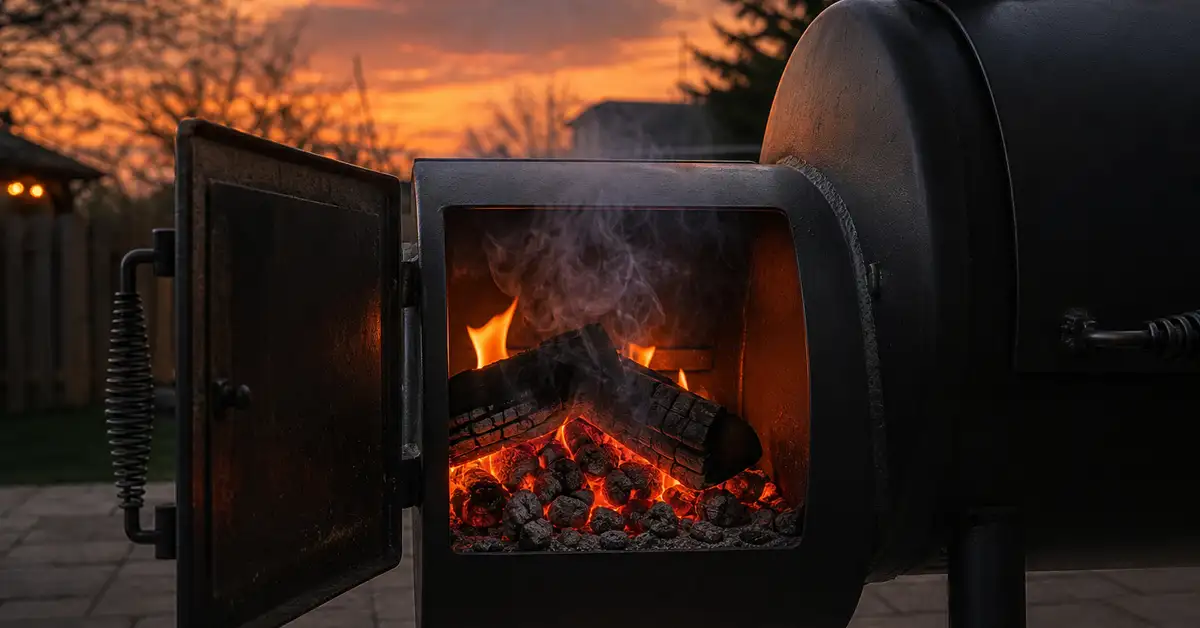
Honestly, for most first-time buyers, no easier fuel exists than offset’s alternatives — and it’s worth saying that plainly before recommending one. A pellet grill holds a set temperature within a few degrees for twelve hours and lets you sleep through an overnight brisket; an offset asks you to add a split of wood every 30–60 minutes, all day, and to stay awake for the whole cook. Nothing about a beginner’s first offset cook is “as tested” or guaranteed — thick white smoke and 40–75°F swings between one end of the chamber and the other are normal rookie territory, and a first offset brisket often tastes worse than the same cut off a pellet grill, simply because the pellet grill’s controller keeps smoke cleaner and temperatures steadier while you’re still learning.
That’s not a reason to avoid offset — it’s the honest frame for choosing it on purpose. If tending a live fire is the part you actually want, if you don’t have (or don’t want to rely on) an outdoor power outlet, or if you like the idea of a steel box with nothing electronic to fail, offset is a legitimate and rewarding first smoker. If what you want is reliable results on cook one and the option to sleep through an overnight brisket, a pellet or electric smoker will get you there faster — see our best smokers for beginners guide for that comparison.
What your first month with a beginner offset actually looks like
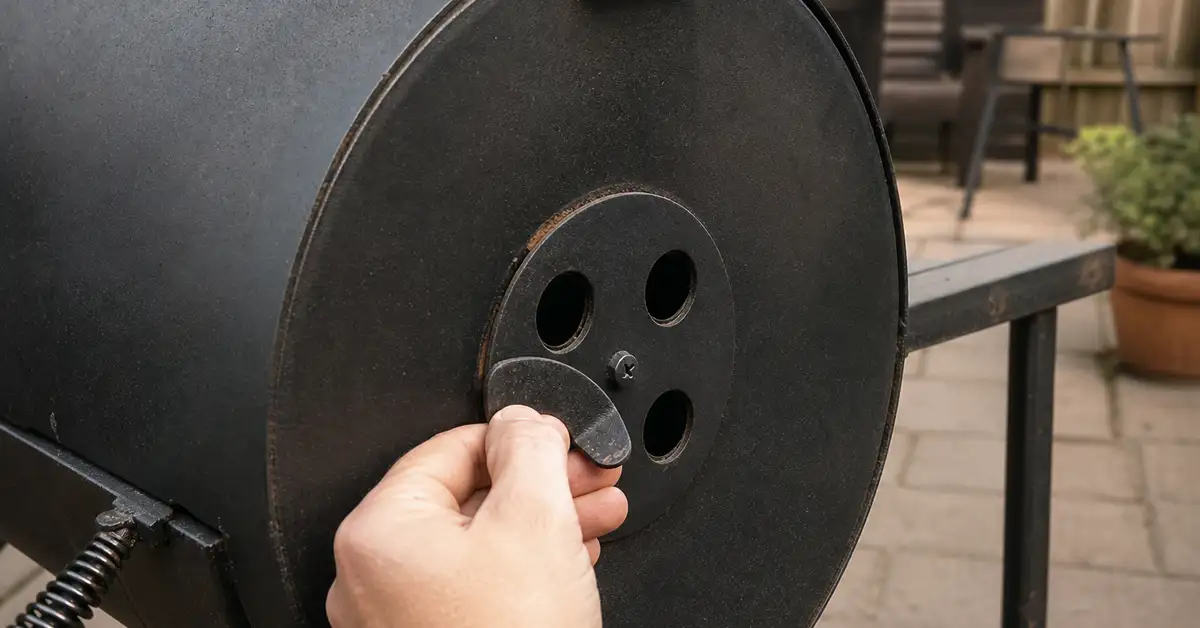
Expect three things in week one, regardless of which pick below you buy. First, fire starting: build a charcoal bed in a chimney starter rather than lighting a raw pile in the firebox, let it ash over (roughly 15–20 minutes), then dump it into the firebox and add wood splits once it’s burning clean. Second, vent discipline: leave the exhaust damper wide open and control temperature with the intake vent instead — closing the exhaust traps stale smoke and turns food bitter. Make small adjustments and wait 10–15 minutes before judging the result; heavy steel responds slowly, and over-correcting is the single most common beginner mistake. Third, reading smoke, not the dial: thin, almost invisible blue smoke is what you want; thick white smoke means too little air, not too little wood — open the intake and wait for it to clear rather than adding more fuel.
Plan on tending the fire every 30–60 minutes for a full cook, and expect to add fuel before the temperature drops rather than after. Cheaper, thinner-steel units in this guide will need it more often than heavier ones. Many first-month owners also end up making a few inexpensive mods: high-temperature gasket tape around a leaky door or firebox seam, an improvised baffle or tuning plate to even out a hot-near-the-firebox gradient, and — almost universally — a real probe thermometer clipped at grate level, since factory dome gauges read high and are mounted in the wrong place to tell you what’s actually happening at the meat. None of this is a defect specific to any one smoker below; it’s simply what offset ownership looks like everywhere on the price spectrum, and it eases off considerably after the first few cooks.
How much does steel gauge matter for a beginner, specifically?
More than almost any other spec. Our full offset smokers guide covers this in depth for buyers across every budget, so we won’t re-derive it here — but for a first-timer, the short version is that thicker steel and better door seals act like a flywheel, storing heat and releasing it slowly so a gust of wind or a door opening doesn’t send your temperature swinging. Thinner, budget barrels heat up and cool down fast, which makes them more responsive but far less forgiving while you’re still learning to read smoke and set vents. That doesn’t rule out a budget starter — it just means you should expect more frequent fire-tending and a higher chance of an early mod or two.
What should a beginner budget for a first offset smoker?
Realistically, three tiers. Our entry tier (under $150) buys a genuinely usable, thinner-steel barrel offset — a fine way to learn the craft cheaply, with the trade-off of more attention and a likely early mod or two. The $150–300 tier starts adding real capacity or a vertical layout with better sealing. From $300–700 upward you’re buying heavier steel, a reverse-flow layout, or both — genuinely more forgiving, but a bigger commitment for a first cooker. There’s no wrong tier to start in; the honest answer is to match the spend to how sure you already are that live-fire cooking is for you.
The 8 best offset smokers for beginners in 2026
Ranked for a genuine first-time offset buyer — every pick names the use case it actually suits, so jump to the one that matches your yard, budget and appetite for fire-tending.
Transparency first: This guide contains affiliate links. If we’re enrolled in an affiliate program, we may earn a commission at no extra cost to you — it never affects how we research or rank. Read our full affiliate disclosure policy.
Oklahoma Joe’s Highland Classic Offset Smoker & Grill
What it is: the offset most cooks are pointed toward as their first genuinely serious stick burner — heavy-gauge, porcelain-coated steel at a price that doesn’t require a long think.
Best for: the beginner who wants real offset barbecue and a smoker built to last, in the traditional layout most tutorials and community mod-guides assume.
Why we rate it: heavy-gauge steel construction, adjustable dampers, and by far the largest owner community and aftermarket of any offset in this guide — which matters enormously for a first-timer hunting for a gasket kit or a baffle-plate mod. Its 879 sq in of total cooking space (616 primary + 263 warming) is plenty for learning without being unwieldy.
Watch-outs: as a traditional (non-reverse-flow) layout it runs hotter near the firebox, so expect to rotate meat; like every offset in this tier it benefits from a gasket seal and a real leave-in thermometer once you’re a few cooks in.
Charcoal/wood · 879 sq in total (616 primary + 263 warming) · heavy-gauge steel · traditional layout · $300–700
Royal Gourmet CC1830S Charcoal Grill with Offset Smoker & Side Table
What it is: a 30-inch charcoal barrel grill with an attached offset firebox and a fold-out side table — one of the most affordable genuine ways to try stick-burning.
Best for: the budget-constrained first-timer who wants real offset cooking, a bit of workspace, and no big up-front commitment.
Why we rate it: around 811 sq in of total cooking space across the main grate, warming rack and offset box, a two-level charcoal pan, and a side table for tools and plates — genuinely usable fundamentals at one of the lowest prices in this guide.
Watch-outs: lighter-gauge steel than the Highland means more temperature swings and a greater chance you’ll want an early gasket or baffle mod; treat it as a genuine first offset to learn on, not a forever pit.
Charcoal/wood · ~811 sq in total · standard-gauge steel · traditional layout · fold-out side table · $150–300
Royal Gourmet CC1830F Charcoal Barrel Grill with Offset Smoker
What it is: the CC1830S’s lighter, table-free sibling — a nearly identical cooking footprint in a smaller, easier-to-place unit.
Best for: a smaller patio or a first-timer who wants the lightest, most portable genuine offset in this guide and doesn’t need the extra side table.
Why we rate it: about 811 sq in of total cooking area on a net weight of just under 50 lb — noticeably easier to reposition or tuck against a wall than most offsets, without giving up real firebox smoking.
Watch-outs: this is the same budget-tier steel as the CC1830S, so expect the same early-mod pattern (gasket, baffle, thermometer) as you settle in. This model also appears on our full best offset smokers roundup as its ultra-budget pick — deliberately, since it earns its place in both a beginner and a budget context.
Charcoal/wood · ~810.9 sq in total · ~49.8 lb · standard-gauge steel · traditional layout · $50–150
Dyna-Glo DGO1176BDC-D Vertical Offset Charcoal Smoker
What it is: a vertical cabinet offset — the firebox sits at the base and heat rises naturally past multiple stacked grates, rather than traveling sideways down a long barrel.
Best for: a beginner with a smaller footprint to work with, or who’d rather manage a smokestack flue than a long horizontal chamber’s hot-and-cool ends.
Why we rate it: 1,176 sq in of total cooking space across multiple height-adjustable grates in a genuinely compact 57 lb unit — vertical convection also tends to run more evenly end-to-end than a horizontal barrel, which is one less variable for a first-timer to fight.
Watch-outs: a smokestack flue is one more control point to learn alongside the intake damper; it’s a small extra layer of complexity in exchange for more even heat.
Charcoal/wood · 1,176 sq in total · ~57 lb · vertical cabinet · adjustable smokestack flue · $300–700
Dyna-Glo DGO1890BDC-D Wide Body Vertical Offset Charcoal Smoker
What it is: the DGO1176BDC-D’s bigger sibling — the same vertical-cabinet layout with a wider body and a pre-installed rope door seal.
Best for: a beginner who already knows they’ll cook for a crowd, or who wants meaningful room to grow without immediately shopping for a second smoker.
Why we rate it: 1,890 sq in of total cooking space across six height-adjustable grates rated 25 lb each, plus a high-temperature rope seal on the primary door that meaningfully cuts down on the heat and smoke loss that plagues thinner-sealed budget units — a genuinely more forgiving first offset than its size might suggest.
Watch-outs: at 83 lb and with six grates to manage, this is a bigger commitment of space and attention than the compact vertical above; buy for the capacity you’ll actually use, not the capacity you might.
Charcoal/wood · 1,890 sq in total · ~83 lb · 6 height-adjustable grates · rope-sealed primary door · $300–700
Char-Griller Smokin’ Champ Barrel Grill and Offset Smoker
What it is: a barrel charcoal grill with an attached side firebox for true offset smoking — one unit that covers both weeknight grilling and weekend low-and-slow.
Best for: the beginner who wants to justify the purchase with everyday grilling, and treat offset smoking as a weekend skill they build into over time.
Why we rate it: 1,235 sq in of total cooking space with 680 sq in on the primary grate, enough for a full spread of direct grilling most days and genuine firebox smoking whenever you’re ready to tend a longer fire.
Watch-outs: as a dual-purpose unit it’s a jack-of-all-trades rather than a dedicated pit — if you already know offset smoking specifically is the goal, the Highland or a Dyna-Glo vertical will teach the craft with fewer distractions.
Charcoal/wood · 1,235 sq in total (680 primary) · barrel + side firebox · traditional layout · $300–700
Char-Griller Competition Pro Offset Smoker Charcoal Grill
What it is: a heavier-duty horizontal offset for the beginner who already knows offset cooking is a long-term hobby, not a trial.
Best for: someone willing to spend more up front for genuinely stable heat, rather than buying a starter and replacing it once they know they’re hooked.
Why we rate it: heavy-duty steel construction, dual damper control (side vent plus smokestack) and premium expanded-metal grates across 1,012 sq in of total cooking area (719 sq in primary) — genuinely more forgiving once heat-soaked than any of the lighter barrels above, at the cost of a longer pre-heat and more fuel per cook.
Watch-outs: this is the priciest pick on this page and a heavier, harder-to-reposition unit; it’s best thought of as a “graduate here once you know you love it” pit rather than a casual first purchase.
Charcoal/wood · 1,012 sq in total (719 primary) · heavy-duty steel · dual damper control · traditional layout · $300–700
Oklahoma Joe’s Highland Offset Reverse Flow Smoker & Grill
What it is: the Highland’s reverse-flow sibling — smoke is routed under a baffle plate to the far end of the chamber and back, evening out temperature across the grate instead of running hottest near the firebox.
Best for: a beginner who’d rather trade a little firebox-side access and flavor purism for a genuinely more even, easier-to-read cooking chamber from day one.
Why we rate it: 1,197 sq in of total cooking space (616 primary + 263 secondary + 281 firebox grate) plus the same heavy-gauge build and huge community/mod support as the standard Highland, with the reverse-flow baffle doing a meaningful share of the temperature-evening work a beginner would otherwise have to manage by rotating meat.
Watch-outs: costs meaningfully more than the standard Highland, and the baffle plate makes direct firebox access slightly less convenient; if budget is tight, the standard Highland above teaches the same fundamentals for less.
Charcoal/wood · 1,197 sq in total (616 + 263 + 281) · heavy-gauge steel · reverse-flow layout · $300–700
Beginner offset smokers compared
Prices move constantly, so we show qualitative price bands (our ladder: under $50 · $50–150 · $150–300 · $300–700 · $700–1,500 · $1,500+) rather than figures that go stale — tap through to check the current price yourself.
| Model | Best for | Cook area | Layout | Price |
|---|---|---|---|---|
| Oklahoma Joe’s Highland Classic | Easiest overall | 879 sq in | Traditional | $300–700 |
| Royal Gourmet CC1830S | Value budget starter | ~811 sq in | Traditional | $150–300 |
| Royal Gourmet CC1830F | Ultra-compact starter | ~811 sq in | Traditional | $50–150 |
| Dyna-Glo DGO1176BDC-D | Compact vertical | 1,176 sq in | Vertical | $300–700 |
| Dyna-Glo DGO1890BDC-D | Large-capacity vertical | 1,890 sq in | Vertical | $300–700 |
| Char-Griller Smokin’ Champ | Grill-and-smoker combo | 1,235 sq in | Traditional | $300–700 |
| Char-Griller Competition Pro | Heavier-gauge step-up | 1,012 sq in | Traditional | $300–700 |
| Oklahoma Joe’s Highland Reverse Flow | Reverse-flow forgiveness | 1,197 sq in | Reverse-flow | $300–700 |
Specs are drawn from manufacturer materials; always confirm current details and availability with the manufacturer or retailer before buying.
Offset smoker safety for beginners, in plain terms
Never add lighter fluid to a lit or hot fire. Build your charcoal bed with a chimney starter and let it fully ash over before it goes near the firebox; adding fluid to an already-burning or still-hot fire can cause a genuine flare-up.
Respect clearance distances. Keep any offset well clear of walls, railings, eaves, dry vegetation and anything combustible, and never leave a lit fire unattended, even briefly.
Carbon monoxide is a real risk with any solid-fuel smoker. Only ever run an offset outdoors, in the open — never in a garage, tent, enclosed porch or covered balcony. Warm coals keep emitting CO even after the visible flame dies down.
Let ash cool fully before disposal. Offset fireboxes hold a lot of ash, and embers can stay dangerously hot for many hours, sometimes overnight. Let it cool completely, then empty it into a dedicated metal container — never straight into plastic, paper or yard waste.
Food safety matters just as much as fire safety. Cook to USDA-safe internal temperatures (poultry to 165°F; whole cuts of beef, pork and lamb to at least 145°F with a 3-minute rest) and confirm doneness with a reliable instant-read meat thermometer rather than trusting time alone — especially useful given how much a beginner’s first-month temperature swings can throw off a clock-based guess. For the fuller storage and shelf-life picture once your cook is done, see how long smoked meat lasts.
Are any of these offset smokers subject to a safety recall?
We screened every pick on this page against the CPSC recall database at the time of research and found no active recall on the Oklahoma Joe’s Highland Classic, Highland Reverse Flow, Royal Gourmet CC1830S, Royal Gourmet CC1830F, Dyna-Glo DGO1176BDC-D, Dyna-Glo DGO1890BDC-D, Char-Griller Smokin’ Champ, or Char-Griller Competition Pro. Worth naming for transparency: a separate, unrelated Royal Gourmet product line — two-burner propane gas grills sold exclusively at Wayfair — was recalled in 2020 over a regulator hose that could melt and catch fire; that recall does not apply to either charcoal offset model on this page. Always confirm current recall status directly at cpsc.gov before buying, especially secondhand.
Related guides
Still deciding between fuel types? See our best smokers for beginners guide. Already sure offset is for you and want the full premium-to-budget range? See our best offset smokers roundup. New to lighting charcoal specifically? Start with how to start a charcoal grill and a good chimney starter. Once your fire’s running, our guide to controlling temperature on a smoker covers the intake-vs-exhaust basics every offset needs, and when you’re ready to cook, see how long to smoke a brisket. Round out the kit with a wireless meat thermometer, our picks for wood chips & chunks, and a properly fitted grill cover — a pit like this lives outdoors year-round.
Frequently asked questions
Is an offset smoker good for a beginner, or should I buy something else first?
It depends on what you want from your first cook. If you want reliable results from day one and the option to sleep through an overnight brisket, a pellet or electric smoker will get you there faster — see our best smokers for beginners guide. If tending a live fire is the part that actually appeals to you, offset is a legitimate and rewarding first smoker, and every model on this page is chosen specifically to forgive a beginner’s early mistakes as much as an offset reasonably can.
What should I budget for a first offset smoker?
Realistically, budget under $150 for a genuinely usable thin-steel barrel starter, $150–300 for more capacity or a vertical layout with better sealing, and $300–700 for heavier steel or a reverse-flow layout. There’s no wrong tier to start in — match the spend to how sure you already are that live-fire cooking is for you.
Do I need to modify a beginner offset right away?
Often, yes, especially on the lighter-steel picks on this page. Common early mods include high-temperature gasket tape on a leaky door or seam, an improvised baffle or tuning plate to even out the chamber, and a real probe thermometer at grate level since factory dome gauges tend to read high. Heavier units like the Competition Pro or Highland Reverse Flow generally need less out of the box.
What’s the difference between traditional and reverse-flow offsets?
A traditional offset runs hottest near the firebox, so you rotate meat to cook evenly. A reverse-flow design routes smoke under a baffle plate to the far end of the chamber and back, evening out the temperature across the grate at the cost of slightly less convenient firebox access and a touch less of the classic offset flavor profile. The Oklahoma Joe’s Highland Reverse Flow on this page is our pick if you’d rather have the baffle do that evening-out work for you.
How often do I need to tend the fire on an offset?
Plan on checking and likely adding fuel every 30–60 minutes for a full cook, more often on lighter-steel budget units and less often on heavier-gauge or reverse-flow models. The rule beginners are taught is to add fuel before the temperature drops, not after, and to judge the fire by smoke color (thin blue, not thick white) rather than the dial alone.
Vertical or horizontal offset for a first-timer?
Both teach the same core skills. Vertical cabinets like the Dyna-Glo models on this page tend to run more evenly end-to-end thanks to natural convection, and suit a smaller footprint or a beginner who wants to manage a smokestack flue instead of a long horizontal chamber’s hot-and-cool ends. Horizontal barrels feel more familiar if you’re coming from a standard charcoal grill and let you sear directly over the firebox as well as smoke low-and-slow.
Are any of these offset smokers subject to a safety recall?
We screened every pick on this page against the CPSC recall database and found no active recall on any of the 8 offset smokers above. A separate, unrelated Royal Gourmet propane gas grill line was recalled in 2020 over a regulator hose issue; it does not apply to either Royal Gourmet charcoal model on this page. Always confirm current recall status directly at cpsc.gov before buying, especially secondhand.
What’s the safest way to dispose of ash from an offset firebox?
Let it cool completely — offset embers can stay hot for many hours, sometimes overnight, even when the smoker looks cool from the outside. Then empty the ash into a dedicated metal container, never straight into plastic, paper or yard waste, where a hidden ember can start a fire hours later.
How we choose
We don’t run a testing lab, and we never fake “as tested.” For this guide we combined manufacturer specifications with reputable outdoor-cooking editorial, independently re-verified every pick’s current availability and specs directly against the manufacturer or a major retailer, and screened every model against the U.S. Consumer Product Safety Commission’s recall database before publishing. We use qualitative price bands rather than prices that go stale. Read more on our How We Choose page.
Sources
Manufacturer product pages: Oklahoma Joe’s (Highland Classic Offset Smoker & Grill model 24203001, Highland Offset Reverse Flow Smoker & Grill model 24203003), Royal Gourmet (CC1830S charcoal grill with offset smoker and side table, CC1830F charcoal barrel grill with offset smoker), Dyna-Glo (DGO1176BDC-D vertical offset charcoal smoker, DGO1890BDC-D wide body vertical offset charcoal smoker), Char-Griller (Smokin’ Champ barrel grill and offset smoker, Competition Pro offset smoker charcoal grill). Retailer listings: Amazon, Walmart. Editorial and comparative coverage on offset fire management and beginner expectations: Smoked BBQ Source, Grate & Grill. Safety and recall screening: U.S. Consumer Product Safety Commission (CPSC.gov). Details were current at the time of research (2026); confirm specifications, pricing and current availability with the manufacturer or retailer before buying.