A kamado grill is a heavily insulated, egg-shaped charcoal cooker — thick ceramic or double-walled steel/aluminum construction that traps heat and moisture and holds a rock-steady temperature for hours on a modest amount of charcoal. It sears like a steakhouse, smokes like a dedicated pit, and bakes a genuinely good pizza, often within the same cook. That versatility is real, but so is the price tag, the weight, and the learning curve — and we think a good buying guide says that plainly rather than just selling you the dream.
We’re a research-led site, not a testing lab, so this guide combines manufacturer specifications with reputable outdoor-cooking editorial (Serious Eats, Food & Wine, Smoked BBQ Source, AmazingRibs) to rank 8 genuinely distinct kamado and kamado-style grills for 2026 — every one individually verified as currently sold, spec-checked against the manufacturer, and screened against active CPSC safety recalls. A quick note on how we price these picks: rather than static prices that go stale, we use qualitative price bands (our ladder: under $50 · $50–150 · $150–300 · $300–700 · $700–1,500 · $1,500+) — think of them as the shopping bucket a pick sits in, not a live price quote. Here’s how we choose.
Our top picks at a glance
- Best overall: Kamado Joe Classic Joe III
- Best for beginners / easiest to run: Char-Griller AKORN Auto-Kamado
- Best budget entry point: Char-Griller AKORN 20-Inch
- Smallest & most portable: Char-Griller AKORN Jr
- Best small ceramic for a balcony: Kamado Joe Joe Jr
- Best for large groups & entertaining: Primo X-Large Oval
- Best for searing & durability: Blaze 20-Inch Cast Aluminum Kamado
- Best value & accessory ecosystem: Vision Grills Professional C-Series
Is a kamado grill actually worth it over a kettle?
This is the honest question to answer before you spend a four-figure sum, and the answer is genuinely “it depends who’s asking.” A kamado’s thick walls hold heat far more efficiently than a thin kettle — owners routinely report smoking a pork shoulder at 225°F for 12+ hours on a single load of lump charcoal, and the same cooker can pivot to 700°F+ for a genuine steakhouse sear or a properly blistered pizza crust, all with vent adjustments rather than a second appliance. That thermal mass also makes kamados noticeably less sensitive to wind and cold than an open kettle, which matters if you cook through winter.
The trade-offs are just as real. A full-size ceramic kamado costs roughly 4–10× a basic kettle grill, weighs anywhere from 70 lb (a small ceramic) to 250+ lb (a large ceramic with cart) making it effectively a permanent fixture rather than something you wheel into a shed, and it has a genuine learning curve: once the ceramic shell is hot, temperature changes lag behind vent adjustments, so new owners have to learn to “sneak up” on a target temperature with small charcoal loads and patient, incremental vent changes rather than fully stoking the fire as they might on a kettle. If you grill simple weeknight dinners and rarely smoke or bake, a kettle remains better value and far easier to store. If you routinely smoke, roast, sear and bake across the seasons — especially somewhere cold or windy — the kamado’s efficiency and versatility earn their keep.
Ceramic or steel: the honest split
Most of what “kamado” conjures — the thick-walled ceramic egg — is genuinely the premium tier, and it comes with a lifetime warranty on the ceramic body from every major brand precisely because that body rarely fails under normal use. But steel and cast-aluminum kamado-style cookers have matured into a legitimate, much cheaper way into the category: triple-walled steel bodies like Char-Griller’s AKORN line trade a little heat-soak and long-term finish durability for a price tag a third to a tenth of a ceramic equivalent, plus meaningfully less weight and no risk of cracking from thermal shock. Four of our eight picks below are steel or cast-aluminum for exactly that reason — we don’t think a page that only lists ceramics gives you the full honest picture of this category. If you want the standard steel-kettle/portable side of charcoal rather than anything kamado-shaped at all, see our best charcoal grills for small spaces guide — that page deliberately leaves ceramic and kamado-style units to this one.
The 8 best kamado grills for 2026
Ranked by who each grill genuinely suits — not by price alone. We didn’t pad this list to hit a round number; every pick below earns a distinct segment.
Transparency first: This guide contains affiliate links. If we’re enrolled in an affiliate program, we may earn a commission at no extra cost to you — it never affects how we research or rank. Read our full affiliate disclosure policy.
Kamado Joe Classic Joe III
What it is: Kamado Joe’s flagship 18-inch ceramic charcoal grill, built around a three-tier Divide & Conquer cooking system and a hyperbolic SlōRoller smoking insert.
Best for: the serious backyard cook who wants genuine multi-zone versatility — searing, smoking and baking at different heights and temperatures in the same cook — without paying for a second appliance.
Why we rate it: the three-tier system takes the nominal 250 sq in main grate to 510 sq in of usable cooking area, the Air Lift hinge meaningfully lightens the dome for one-handed opening, and the Kontrol Tower top vent gives precise, repeatable airflow control. Kamado Joe backs the ceramic body with a limited lifetime warranty to the original owner.
Watch-outs: at roughly 360 lb with cart, this is a permanent fixture, not something you reposition casually — plan its spot before you buy. The three-tier system has a genuine learning curve of its own on top of standard kamado vent management.
Ceramic · 250 sq in primary / 510 sq in with 3-tier system · 225–750°F · ~360 lb with cart · lifetime ceramic / 5-yr metal / 3-yr electronic / 2-yr misc warranty · $1,500+
Char-Griller AKORN Auto-Kamado
What it is: a steel-bodied AKORN kamado with a built-in digital controller that automates airflow — set a target temperature and the controller manages the vents for you, rather than you managing them by hand.
Best for: a genuine first kamado — someone who wants the versatility of the category without the vent-management learning curve that trips up most new owners.
Why we rate it: the digital controller genuinely removes the single hardest skill in kamado cooking (holding a steady low temperature), while the triple-walled steel body still delivers the 200–700°F range and fuel efficiency of the category at a fraction of ceramic pricing.
Watch-outs: it’s still a steel body, not ceramic — less heat-soak and a shorter expected finish life than a premium ceramic egg. The digital controller is one more component that can eventually need service, versus the pure-mechanical simplicity of a standard AKORN.
Steel, triple-wall · 314 sq in primary / 447 sq in total · 200–700°F · digital controller · 1-yr parts / 5-yr rust-through warranty · $300–700
Char-Griller AKORN 20-Inch
What it is: the standard steel AKORN kamado — the grill that made ceramic-style cooking affordable in the first place, unchanged in its fundamentals for over a decade.
Best for: buyers who want to try genuine kamado cooking — low-and-slow smoking, high-heat searing, real fuel efficiency — without a four-figure commitment.
Why we rate it: triple-walled insulation delivers real heat retention at roughly a tenth of premium ceramic pricing, the 314 sq in primary grate plus 133 sq in warming rack is genuinely generous for the price, and at around 85–100 lb it’s light enough to reposition without a second person.
Watch-outs: manual vent management only, with the same learning curve as any kamado. Steel construction means watching for rust over the years, and the finish and long-term durability don’t match a ceramic egg.
Steel, triple-wall · 314 sq in primary / 445–447 sq in total · 200–700°F · ~85–100 lb · 1-yr parts / 5-yr rust-through warranty · $150–300
Char-Griller AKORN Jr
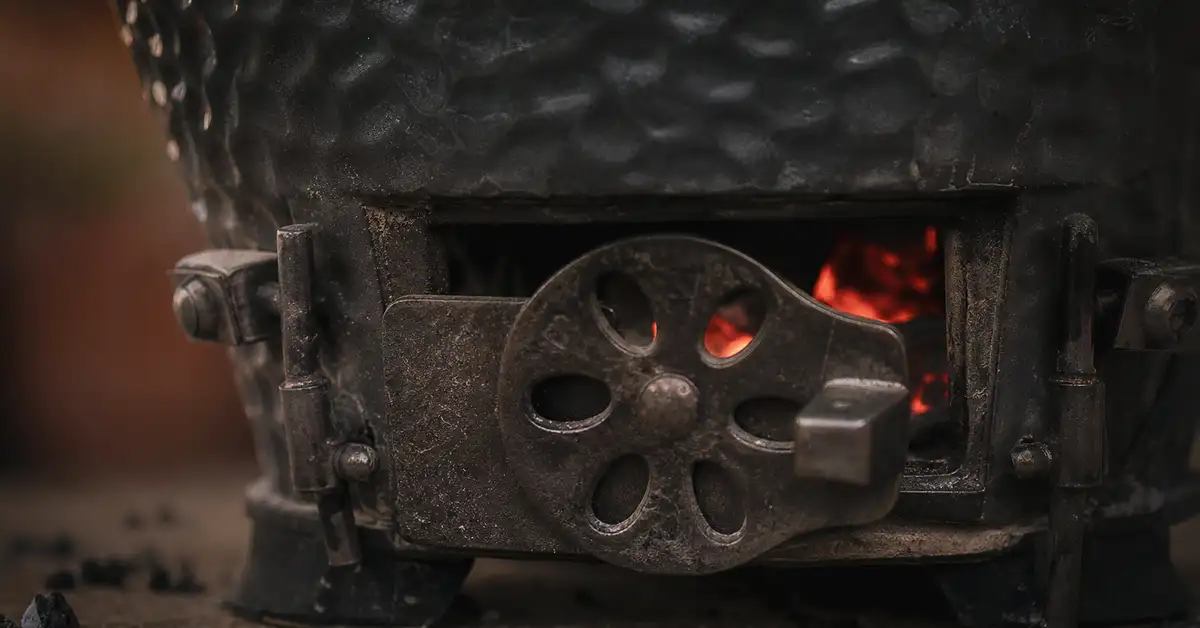
What it is: a genuinely compact steel kamado — the AKORN’s design shrunk down for camping, tailgating and small patios, with side handles built for carrying, not just wheeling.
Best for: the lightest, cheapest way into real kamado cooking — couples, small balconies (where locally permitted), and anyone who wants the option to actually pick the grill up and move it.
Why we rate it: at roughly 31–36 lb it’s the only grill on this page one person can carry rather than wheel, it shares the same 200–700°F range and triple-wall insulation as its full-size sibling, and its price is low enough to treat as an experiment rather than a commitment.
Watch-outs: about 153–155 sq in of cooking space is genuinely small — comfortable for two to four people, tight for a group. It’s the same honest steel-vs-ceramic trade-off as the full-size AKORN, just in a smaller footprint.
Steel, triple-wall · 153–155 sq in total · 200–700°F · ~31–36 lb · 1-yr parts / 5-yr rust-through warranty · $150–300
Kamado Joe Joe Jr
What it is: a genuine 13.5-inch ceramic kamado on a small cast-iron stand — the same thermal mass and construction as Kamado Joe’s full-size grills, scaled down.
Best for: buyers who specifically want ceramic heat retention and real searing performance in a size that suits a balcony, small patio, or occasional tailgate, rather than settling for a steel small kamado.
Why we rate it: it delivers genuine ceramic performance — real heat-soak, real high-heat searing — at roughly a quarter of the price of a full-size ceramic egg, and Kamado Joe backs it with the same lifetime ceramic warranty as its larger grills.
Watch-outs: about 148 sq in of cooking space suits two to three people, not a gathering. At 68–77 lb it’s heavier than it looks for something marketed as “portable” — expect to need both hands to move it.
Ceramic · ~148 sq in · 225–750°F · ~68–77 lb · lifetime ceramic / 5-yr metal / 3-yr electronic / 2-yr misc warranty · $300–700
Primo X-Large Oval
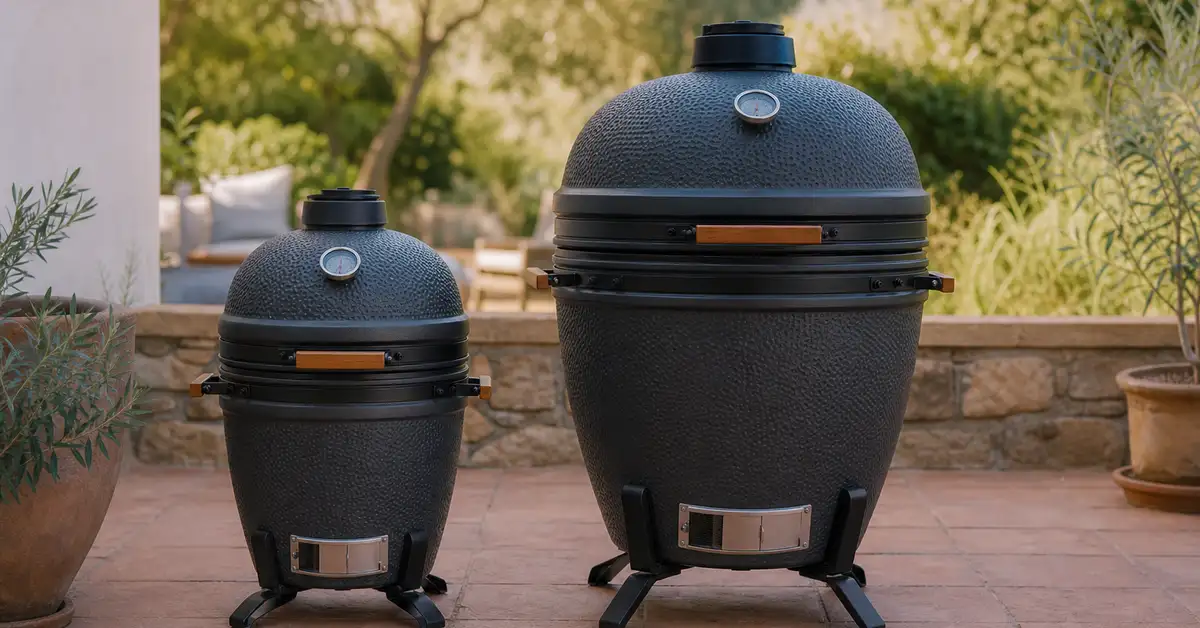
What it is: Primo’s patented oval ceramic kamado — a genuinely different shape from the round eggs on this page, designed to make direct and indirect zones easier to run side by side.
Best for: buyers who regularly cook for a crowd and want distinct hot and cool zones on one grate, rather than juggling a multi-tier round system.
Why we rate it: 400 sq in of primary cooking area, expandable to 680 sq in with the optional rack system, is genuinely enough for eight whole chickens or ten racks of ribs at once by Primo’s own figures, and the oval shape makes a clean direct/indirect split easier to maintain than a round grate. The temperature range of roughly 151–850°F is among the widest on this page.
Watch-outs: at around 250 lb for the grill alone (more with a cart), this is entertaining-scale equipment, not a casual weeknight grill. Primo’s accessory ecosystem and dealer network are narrower than Kamado Joe’s or Big Green Egg’s.
Ceramic, oval · 400 sq in primary / 680 sq in with rack · 151–850°F+ · ~250 lb · 20-yr ceramic / 5-yr metal / 1-yr cast iron / 30–90-day gasket & thermometer warranty · $1,500+
Blaze 20-Inch Cast Aluminum Kamado
What it is: a cast-aluminum kamado — a genuinely different construction from both ceramic and steel, built to be effectively immune to the cracking and rust that can affect the other two materials.
Best for: buyers who prioritize long-term durability and low maintenance over outright cooking area — especially in climates with freeze-thaw cycles that are hard on ceramic.
Why we rate it: the tongue-and-groove lid seal eliminates gasket replacement entirely, the thick 20-inch stainless hex grate sears extremely well, and Blaze backs the cast-aluminum body, grates, hinge and all other parts with a lifetime warranty. It also tolerates any charcoal, briquettes or wood without absorbing odors the way a porous ceramic body can.
Watch-outs: retailers list this grill’s cooking area inconsistently — anywhere from about 315 to 400 sq in depending on whether the secondary stainless grate is counted — so treat the primary 20-inch grate as the reliable figure and confirm the current listing before you buy. The aluminum exterior also runs hotter to the touch during a cook than a ceramic body.
Cast aluminum · ~315–400 sq in (retailer listings vary) · up to 700°F+ · ~161 lb · lifetime warranty on body, grates, hinge & all parts · $1,500+
Vision Grills Professional C-Series
What it is: a large ceramic kamado built around Vision’s ProZone system — an electric starter port and dedicated smoking/grilling knobs that add real instrumentation most kamados don’t offer.
Best for: buyers who want more cooking area per dollar than the premium ceramic brands, plus features that make day-to-day operation genuinely easier — without the Big Green Egg or Kamado Joe price tag.
Why we rate it: 604 sq in across two stainless tiers is more total cooking area than a Large Big Green Egg (262 sq in) at a meaningfully lower typical price, the electric starter port and removable ash drawer are conveniences most competitors charge extra for or omit, and the ceramic body carries a limited lifetime warranty.
Watch-outs: Vision’s dealer and accessory network is smaller than Big Green Egg’s or Kamado Joe’s, so third-party accessory compatibility is more limited. At roughly 227–231 lb it’s still large-ceramic-scale equipment.
Ceramic · 604 sq in (302 + 302 two-tier) · ~180–700°F · ~227–231 lb · lifetime ceramic / 5-yr metal / 3-yr shelves / 1-yr gauge & gasket / 90-day misc warranty · $700–1,500
Kamado grills compared
Prices move constantly, so we show qualitative price bands (our ladder: under $50 · $50–150 · $150–300 · $300–700 · $700–1,500 · $1,500+) rather than figures that go stale — tap through to check the current price yourself.
| Model | Material | Best for | Cooking area | Price |
|---|---|---|---|---|
| Kamado Joe Classic Joe III | Ceramic | Overall | 510 sq in (tiered) | $1,500+ |
| Char-Griller AKORN Auto-Kamado | Steel | Beginners / digital control | 447 sq in | $300–700 |
| Char-Griller AKORN 20-Inch | Steel | Budget entry | 445–447 sq in | $150–300 |
| Char-Griller AKORN Jr | Steel | Smallest / most portable | 153–155 sq in | $150–300 |
| Kamado Joe Joe Jr | Ceramic | Small ceramic / balcony | ~148 sq in | $300–700 |
| Primo X-Large Oval | Ceramic | Large groups | 400 / 680 sq in | $1,500+ |
| Blaze 20-Inch Cast Aluminum | Cast aluminum | Searing / durability | ~315–400 sq in | $1,500+ |
| Vision Grills Professional C-Series | Ceramic | Value & accessories | 604 sq in | $700–1,500 |
Specs are drawn from manufacturer materials and reputable editorial sources; always confirm current details and price with the manufacturer or retailer before buying.
Kamado safety: flashback, thermal shock, weight and embers
Kamados carry a few hazards that don’t come up with a simple kettle or gas grill, and a buying guide that skips them isn’t doing its job.
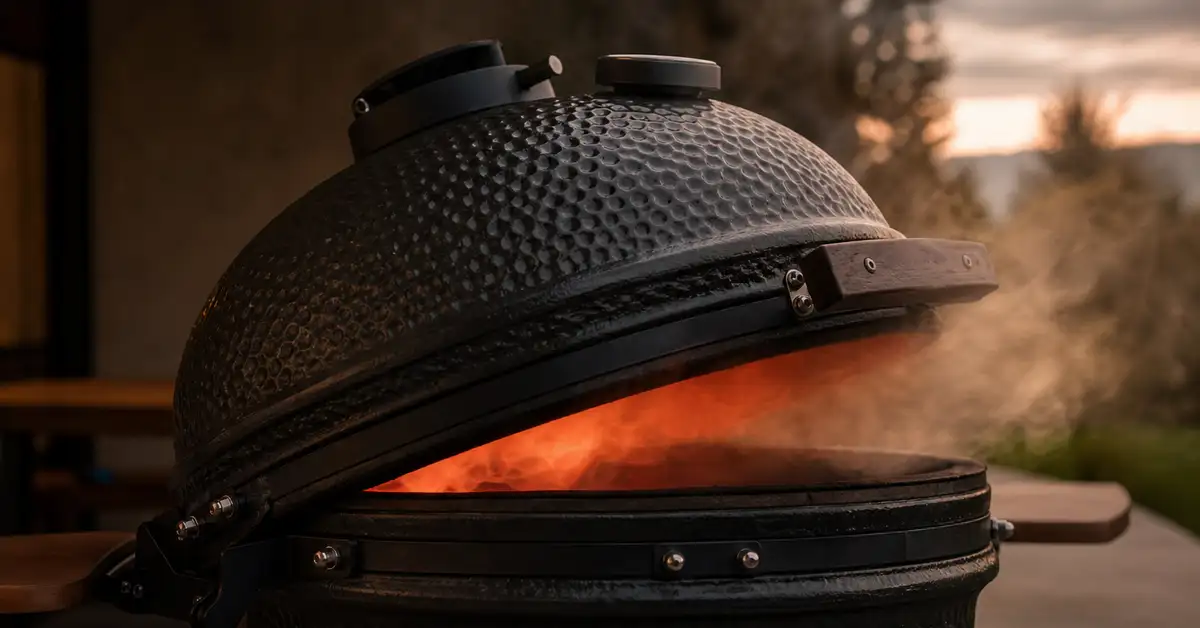
Flashback / backdraft. If a kamado has been running hot with the vents closed down, the chamber can fill with heated, oxygen-starved combustible gases. Opening the lid suddenly lets a rush of oxygen in and can cause those gases to ignite in a burst of flame — a real hazard, not a myth. The fix is “burping” the grill: crack the lid an inch or two, pause, and repeat two or three times before opening it fully, especially above 400°F. Wear heat-resistant gloves and keep your face and children clear while you do it.
Thermal shock and ceramic cracking. Ceramic bodies can crack from rapid, extreme temperature swings — dousing a hot grill with cold water, or fully opening the vents to cool it down fast. Let a ceramic kamado heat up and cool down gradually, never pour liquid on hot ceramic, and keep it covered and dry in freezing weather. Steel and cast-aluminum kamados don’t share this specific risk, which is one honest reason to consider them.
Weight and tip-over risk. Large ceramic kamados run 160–360+ lb with cart, which makes a sturdy, level, load-bearing surface and a cart with locking casters genuinely important — not a nice-to-have. Never place a kamado near a deck edge or on an unstable surface, and keep an eye on hinge and band hardware over time, since a worn hinge can let a heavy lid drop unexpectedly.
Embers stay hot for a long time. A well-insulated kamado’s coals can smolder for many hours after you close the vents down. Let the grill fully cool before emptying ash, and always use a metal ash container — never plastic or straight into yard waste.
Outdoor use only, on every kamado without exception: never run a charcoal kamado in a garage, tent, enclosed porch or other enclosed space — carbon monoxide buildup from any fuel-burning grill is a genuine and sometimes fatal hazard. Food safety matters here too: follow USDA-consistent internal temperatures and confirm doneness with a good instant-read meat thermometer rather than guessing.
Are there any recalls to know about on these grills?
We screened every pick on this page against the CPSC recall database at the time of research, and found no active recall on the Kamado Joe Classic Joe III, Joe Jr, Char-Griller AKORN Auto-Kamado, AKORN 20-Inch, AKORN Jr, Primo X-Large Oval, Blaze 20-Inch Cast Aluminum Kamado, or Vision Grills Professional C-Series. A few things worth naming for context: three 2026 CPSC recalls cover metal wire-bristle grill brushes — a cleaning accessory, not a grill — from Weber, Nexgrill and Conair/Cuisinart; none of the grills on this page are affected, but if you own an older wire brush from any of those brands, check it and switch to a bristle-free brush or scraper. We also found a private law firm’s non-CPSC investigation into fire risk on certain pellet-fed Pit Boss grills — a different fuel type and product line from the ceramic kamados on this page, and not a recall. Always confirm current recall status with the manufacturer and CPSC before buying, especially secondhand.
Frequently asked questions
Is a kamado grill worth it over a kettle grill?
For most casual weeknight grillers, a kettle is better value and much easier to store. For cooks who routinely smoke, sear and bake across the seasons — especially in cold or windy climates — a kamado’s heat retention and fuel efficiency genuinely earn the higher price and weight. There’s no universally correct answer; it depends on how you actually cook.
What’s the difference between a ceramic and a steel kamado?
Ceramic bodies hold heat more evenly and for longer, and every major ceramic brand backs the body with a lifetime warranty. Steel (and cast-aluminum) kamado-style grills trade some of that heat-soak and long-term finish durability for a price a third to a tenth of ceramic, plus lighter weight and no risk of thermal-shock cracking. Both are legitimate ways into the category.
How much does a good kamado grill cost?
Genuinely useful steel kamados typically run $150–300 to $300–700, a small ceramic like the Kamado Joe Joe Jr usually sits around $300–700, and full-size premium ceramics from Kamado Joe, Big Green Egg or Primo typically run $1,500+ once you include a cart. Mid-tier ceramics like Vision Grills’ Professional C-Series sit in between, often in the $700–1,500 range.
How do you avoid flashback (backdraft) on a kamado?
Never fully open the lid on a hot, vented-down kamado. Instead, “burp” it: crack the lid an inch or two, pause a few seconds, and repeat two or three times to let oxygen mix in gradually before opening it the rest of the way. Wear heat-resistant gloves and keep your face clear while you do this, especially above 400°F.
Can a kamado grill crack?
Ceramic kamados can crack from thermal shock — rapid, extreme temperature swings, like pouring cold water on a hot grill or fully opening the vents to cool it down fast. Heat up and cool down gradually, never let liquid hit hot ceramic, and keep the grill dry and covered in freezing weather. Steel and cast-aluminum kamados don’t share this specific risk.
How long does charcoal last in a kamado?
Thanks to the insulated body and tight vent control, a single load of lump charcoal can hold a low-and-slow smoking temperature (around 225°F) for 12 or more hours in a full-size kamado — genuinely longer than an open kettle on the same fuel load, which is one of the category’s biggest practical advantages.
Are there any recalls to know about on these kamado grills?
As of our 2026 research, we found no active CPSC recall on any of the 8 grills on this page. Three 2026 wire-bristle grill-brush recalls (Weber, Nexgrill, Conair/Cuisinart) cover a cleaning accessory, not a grill, and don’t apply to any pick here. A separate law-firm investigation into fire risk on certain pellet-fed Pit Boss grills is not a CPSC recall and concerns a different product line entirely.
What internal temperatures should I cook to on a kamado?
Follow USDA/FoodSafety.gov guidance regardless of which grill you use: poultry to 165°F; ground meats to 160°F; whole cuts of beef, pork, veal and lamb to at least 145°F with a 3-minute rest; fish to 145°F. Confirm doneness with a reliable instant-read meat thermometer rather than relying on a built-in dome thermometer alone.
Keeping a kamado grill running safely
A kamado rewards a little routine maintenance more than most grills, precisely because its insulation hides problems that would be obvious on an open kettle. Empty the ash and check the firebox before every cook, since a clogged airway is the most common cause of a kamado that won’t hold temperature. Inspect the gasket and hinge occasionally — a worn gasket lets heat and smoke leak, and a worn hinge can let a heavy lid drop unexpectedly. Store lump charcoal somewhere bone-dry, since damp charcoal burns unevenly and smokes more. Let a full cool-down cycle finish before covering the grill, and never operate any charcoal grill in a garage, tent or other enclosed space because of carbon monoxide risk. A properly fitted grill cover is cheap insurance against rust and UV damage between cooks.
Related guides
Want a simpler, cheaper charcoal grill instead of a kamado, or unsure whether charcoal is even the right fuel for you? See our best charcoal grills for small spaces guide for standard steel kettle/portable options, or our best smokers for beginners guide, which compares fuel types honestly. New to lighting charcoal specifically? Our how to start a charcoal grill guide covers the chimney-starter method, the 15–20 minute ash-over rule, and the two-zone setup every kamado owner should know too. Before your first cook, our guide on how to season a grill covers prepping cast-iron and porcelain-coated grates the right way. Rounding out the kit: don’t cook without one of our best instant-read meat thermometers, stock up on wood chips and chunks for extra smoke flavor, season the right rub with our best BBQ rubs and seasonings guide, keep your new grill spotless with how to clean a grill, and protect your investment with a properly fitted grill cover. Shopping around the holidays instead? See our Black Friday grill & smoker deals guide.
How we choose
We don’t run a testing lab, and we never fake “as tested.” For this guide we combined manufacturer specifications with reputable outdoor-cooking editorial (Serious Eats, Food & Wine, Smoked BBQ Source, AmazingRibs) and independently re-verified every pick’s current availability, specs and pricing directly against the manufacturer and multiple retailers — one candidate we initially considered (Pit Boss’s K24 ceramic kamado) turned out to be absent from the manufacturer’s current grill catalog despite an active product page, so we excluded it rather than publish an uncertain existence claim. We screened every pick against the U.S. Consumer Product Safety Commission’s recall database before publishing, and where retailer specs genuinely conflicted (as with the Blaze kamado’s cooking area), we said so rather than picking a number that looked cleaner. We use qualitative price bands rather than prices that go stale. Read more on our How We Choose page.
Sources
Manufacturer product pages: Kamado Joe (Classic Joe III, Joe Jr), Char-Griller (AKORN 20-Inch, AKORN Jr, AKORN Auto-Kamado), Primo Ceramic Grills (X-Large Oval), Blaze Outdoor Products (20-Inch Cast Aluminum Kamado), Vision Grills (Professional C-Series). Editorial and comparative coverage: Serious Eats, Food & Wine, Smoked BBQ Source, AmazingRibs, The Barbecue Lab. Safety and recall data: U.S. Consumer Product Safety Commission (CPSC) recall database. Specifications were current at the time of research (2026) and should be reconfirmed with the manufacturer or retailer before purchase.