A portable gas grill is a compact, propane-fueled grill built to be carried, folded or wheeled — on a tabletop, a tailgate, a camping trip or a small patio — rather than parked permanently in one spot. The best ones trade some cooking area for genuine portability without giving up real searing heat.
“Best small gas grill” isn’t one product — it’s balcony cooks, tailgaters, campers and small-patio owners all searching for something different. We’re a research-led site, not a testing lab, so this guide pulls together manufacturer specifications and reputable outdoor-living editorial (Serious Eats, Food & Wine, OutdoorGearLab, Wirecutter) to rank 8 genuinely small or portable gas grills for 2026 — every one individually verified as currently sold, spec-checked against the manufacturer, and screened against active safety recalls. Here’s how we choose.
How small is “small”? A quick guide to the classes
Portable gas grills split into three rough size classes, and knowing which one you actually want saves a lot of scrolling:
| Class | Typical cooking area | Best for |
|---|---|---|
| Ultra-compact tabletop | 150–200 sq in | Balconies, couples, minimal storage |
| Mid-size portable | 225–290 sq in | Camping, tailgating, small families |
| Stand-up / wheeled portable | 300–320+ sq in | Frequent travel, small groups, a genuine second grill |
Nothing in this guide crosses roughly 320 square inches of cooking area, and every pick either folds, latches shut, or wheels — a bigger single-burner grill on a fixed cart isn’t on this list, however good it is.
Want a full-size grill instead? See our best gas grills for the money guide — full-size 2–5 burner cart grills built to live permanently on a patio, not to travel. There’s no overlap between that list and this one; it’s a genuine product-class split, not just a price difference.
BTU is a marketing number, not a quality number
It’s tempting to shop by BTU the way you’d shop by horsepower, but on a small grill it’s a poor proxy for quality. A single 8,500 BTU burner concentrated over 189 square inches (like the Weber Q1200) sears just as well as a 20,000 BTU three-burner grill spread across 285 square inches — because what actually matters is BTU density (heat per square inch), burner design, and how well the grate and firebox retain that heat. A bigger BTU figure on the box mostly tells you the grill covers more area, not that it cooks better. Judge a small gas grill on grate material, even heat distribution and honest owner reports of hot/cool spots — not the number on the spec sheet.
Propane or pellet? The honest split
If you’re also weighing a small pellet grill, the difference is fuel and philosophy, not quality. Propane gives you instant heat, no electricity, and predictable, easy-to-learn temperature control — genuinely the easier fuel to travel with, since 1 lb cylinders are cheap and everywhere. Pellet grills add real wood-fired flavor and set-and-forget automation, but need power and a bag of pellets on hand. If you want to be cooking dinner five minutes after you park the car, gas wins; if wood-fired flavor matters more than convenience, look at our pellet guide instead. Neither is the “wrong” choice — they’re different tools.
Natural gas or propane: which should you buy?
Every grill in this guide is propane by default, but two of our picks are available in a factory-built natural gas version. If your patio has a plumbed gas line, a genuine NG model is the way to go — not a propane grill with an aftermarket conversion kit. Manufacturers size the regulator and burner orifices specifically for natural gas’s lower pressure and different calorific value; non-approved conversion kits have been linked to gas leaks and burner problems in past CPSC actions, and using one voids the manufacturer’s warranty. If you want natural gas, buy the model built for it.
How long does a propane cylinder last?
Rough math: a pound of propane holds about 21,000 BTU, so a 1 lb disposable cylinder on an 8,500–9,500 BTU single-burner grill (like the Q1200 or Grill2Go X200) gives you roughly 2–2.5 hours of continuous high-heat cooking — plenty for a cookout, tight for a long weekend. A 20 lb tank on the same burner stretches that to 40+ hours. Multi-burner portables running 20,000 BTU across three burners (like the RoadTrip 285) will burn through a 1 lb cylinder in under an hour on high, which is exactly why several of our picks accept an adapter hose to a full-size 20 lb tank for longer trips.
Can you use a gas grill on a balcony or apartment patio?
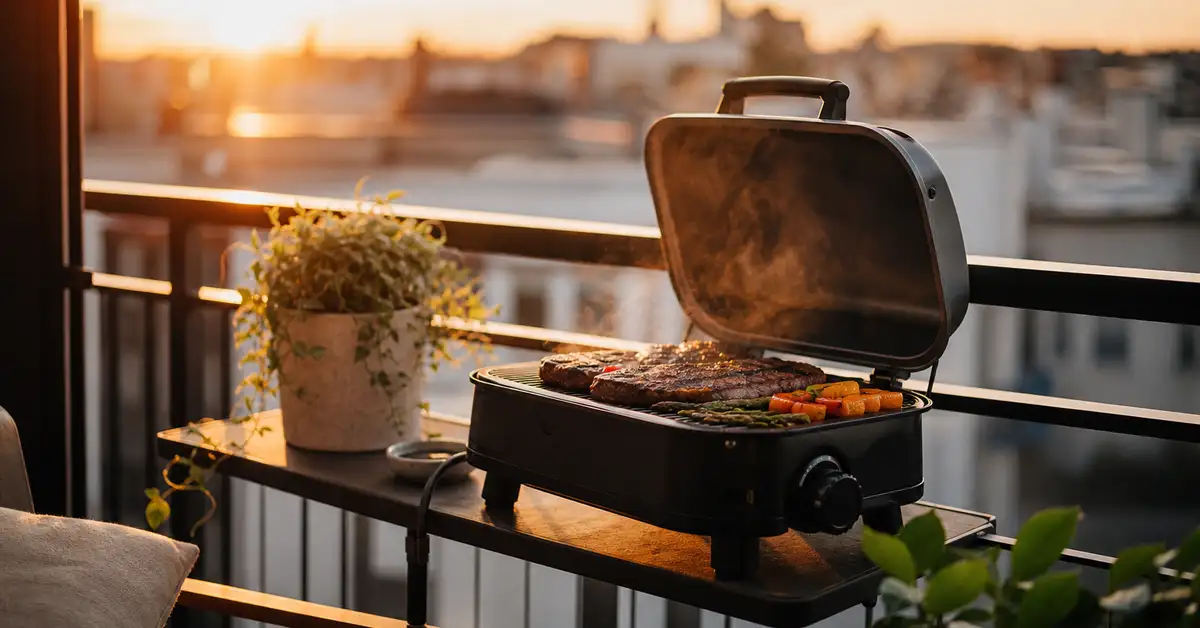
Be careful here — this is genuinely restricted in a lot of places. Many apartment leases, condo bylaws and municipal fire codes prohibit propane grills on balconies and covered patios entirely, regardless of how small the grill is, because of fire risk and carbon monoxide buildup in enclosed spaces. Before you buy for balcony use, check your lease and local fire code first — don’t assume a “balcony-sized” grill is automatically a “balcony-legal” grill. Where it is allowed, only ever grill in the open air, never under a low overhang or in an enclosed space, and keep the grill well clear of railings and siding.
The 8 best small & portable gas grills for 2026
Ranked by use case, not by size alone — jump to the one that matches how you’ll actually use it.
Transparency first: This guide contains affiliate links. If we’re enrolled in an affiliate program, we may earn a commission at no extra cost to you — it never affects how we research or rank. Read our full affiliate disclosure policy.
1. Weber Q 1200 Gas Grill
What it is: Weber’s core single-burner tabletop propane grill — a cast-aluminum body with a porcelain-enameled cast-iron grate that’s barely changed in over a decade because it doesn’t need to.
Best for: the buyer who wants one dependable small grill for two to four people, with Weber’s dealer network and parts support behind it.
Why we rate it: an 8,500 BTU stainless burner heats the full 189 sq in grate evenly, folding side tables cut the footprint for storage, and the cookbox carries a 5-year warranty against rust-through. It can also run off a full 20 lb tank via an adapter hose, not just 1 lb disposables.
Watch-outs: no lid latch — the lid stays shut by friction, not a mechanical catch, so it’s better suited to placing on a surface than to rough transport.
Propane · 1 burner, 8,500 BTU · 189 sq in porcelain-enameled cast-iron grate · electronic ignition · 31 lb · folding side tables · 5-yr cookbox warranty · $150–300
2. Cuisinart CGG-180 Petit Gourmet Portable Gas Grill
What it is: a genuinely small single-burner grill built around an integrated telescoping VersaStand, so it works as either a tabletop grill or a low freestanding unit without extra parts.
Best for: the smallest realistic footprint in this guide — couples, tight balconies (where locally permitted) and anyone who wants to store a grill in a closet, not a shed.
Why we rate it: a 150 sq in porcelain-enameled grate, twist-to-start ignition, a lid latch and a carry handle mean it genuinely packs up and goes, and the fold-up VersaStand base is a smarter piece of engineering than most grills this cheap bother with.
Watch-outs: the smallest cooking area in this guide — fine for 2–4 people, tight for more, and the 5,500 BTU burner is the mildest here.
Propane · 1 burner, 5,500 BTU · 150 sq in porcelain-enameled grate · twist-to-start ignition · telescoping VersaStand, lid latch · 3-yr warranty · $150–300
3. Char-Broil Grill2Go X200
What it is: a rugged, latch-secured travel grill built like a toolbox — no assembly, no separate stand, just open the case-style firebox and light it.
Best for: the cheapest genuinely well-built pick here, and the one we’d trust most for rough handling — truck beds, boat decks, campsites.
Why we rate it: secure stainless steel latches lock the lid shut for transport (rare at this price), a cast-aluminum firebox and high-impact frame shrug off knocks, and Char-Broil’s Amplifire infrared system reduces flare-ups on a 9,500 BTU burner.
Watch-outs: at 200 sq in it’s a genuine two-to-three-person grill, and there’s no folding stand — it needs a table or tailgate to sit on.
Propane · 1 burner, 9,500 BTU · 200 sq in cooking area · push-button electronic ignition · locking latch, no-assembly design · ~20–25 lb · 5-yr burner/lid warranty · $150–300
4. WEBER TRAVELER Portable Gas Grill
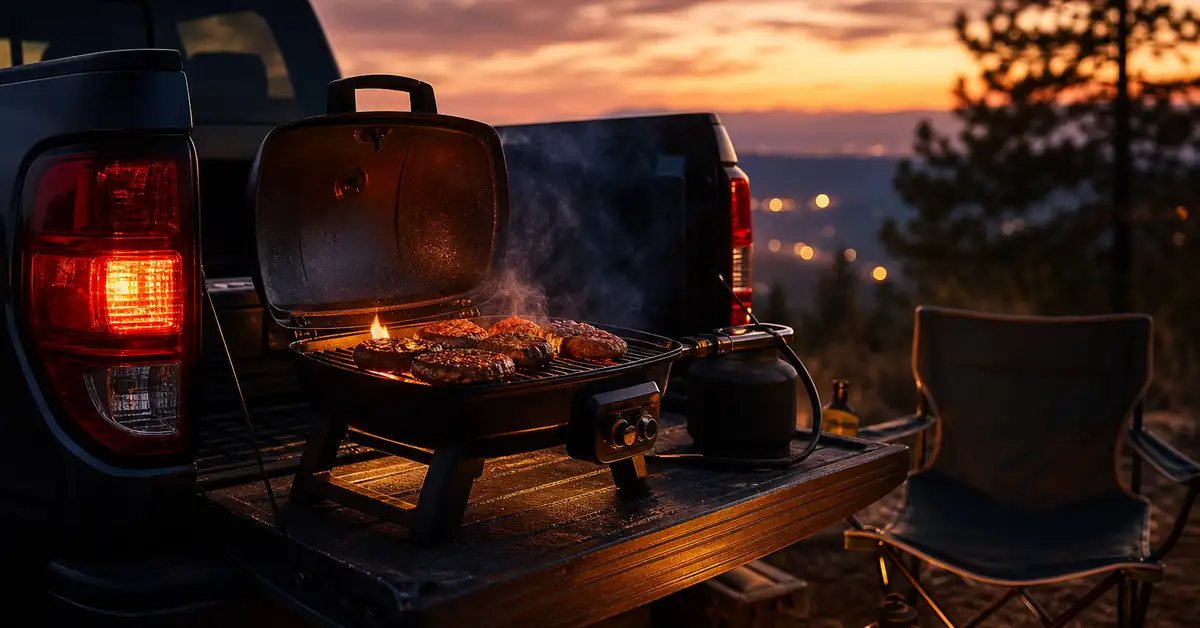
What it is: a single-burner grill built into a wheeled, one-hand-folding cart — no separate table needed, and it rolls like a suitcase when collapsed.
Best for: tailgaters and road-trippers who want a grill big enough to feed a small group but still fits in most SUVs.
Why we rate it: a 320 sq in grate (Weber’s largest true single-burner portable), a lid that locks automatically when folded, two all-weather wheels, and a lever that raises and lowers the stand with one hand — genuinely useful in a parking lot with no help.
Watch-outs: the wheeled cart makes it less compact than a tabletop unit for tight balcony storage, and at 49 lb it’s a two-hand carry into a trunk.
Propane · 1 burner, 13,000 BTU · 320 sq in porcelain-enameled cast-iron grate · electronic ignition · locking lid, wheeled folding cart · 49 lb · 5-yr warranty · $300–700
5. Coleman RoadTrip 285 Portable Stand-Up Propane Grill
What it is: a three-burner stand-up grill on quick-fold, wheeled legs, with independently adjustable zones and a swappable SwapTop cooking surface.
Best for: campers who want real two-zone (or three-zone) temperature control — sear on one burner, hold warm on another — in a grill that still folds down for the car.
Why we rate it: 20,000 BTU across three independently adjustable burners is genuinely useful control for a portable, Instastart push-button ignition lights every burner reliably, and a removable water pan catches grease before it becomes a flare-up.
Watch-outs: the folded footprint is bigger than a tabletop grill, and 1 lb cylinders won’t last long across three burners on high — plan on the 20 lb tank adapter for longer sessions.
Propane · 3 burners, 20,000 BTU total · 285 sq in cooking area · Instastart electronic ignition · quick-fold legs + wheels, locking lid · 49 lb · 3-yr warranty · $300–700
6. Cuisinart CGG-306 Chef’s Style Stainless Tabletop Grill
What it is: a stainless two-burner tabletop grill that Cuisinart pitches as rivaling a full-size backyard grill — and on paper, the numbers back that up.
Best for: a small patio or deck where you want two independently controlled zones without committing to a full cart grill.
Why we rate it: 20,000 BTU across two burners onto a 275 sq in stainless grate is a lot of cooking power for a tabletop unit, and dual independent burner control means you can sear and hold warm at the same time.
Watch-outs: no folding legs or wheeled stand — it’s a tabletop grill in the literal sense, so you’ll need a table, cart or sturdy surface to put it on.
Propane · 2 burners, 20,000 BTU total · 275 sq in stainless steel grate · electronic ignition · carry handles, no stand · ~22–24 lb · 3-yr warranty · $150–300
7. Weber Q 2800N+ Gas Grill
What it is: the current, larger flagship of Weber’s portable Q lineup — the direct replacement for the older Q2200, now with a second small burner built into the middle of the grate.
Best for: buyers who want genuine step-up cooking area and power in a still-portable Weber, and who’ll appreciate the extra “+” burner for indirect cooking or holding food warm.
Why we rate it: a main 18,000 BTU burner plus a 4,000 BTU center “+” burner spread heat across 320 sq in — 14% more cooking area and roughly 50% more BTU than the outgoing Q2200 it replaced — and Weber backs the cookbox, lid, burner tubes and grates with 5-year warranties.
Watch-outs: this genuinely supersedes the older Q2200, which is being phased out of Weber’s current US lineup — don’t buy new-old-stock Q2200 units expecting identical support going forward, and confirm you’re looking at the 2800N+ specifically.
Propane · main burner 18,000 BTU + 4,000 BTU center burner · 320 sq in cooking area · electronic ignition · ~32 lb (grill only) · 5-yr warranty on major components · $300–700
8. Napoleon TravelQ PRO285N Portable Natural Gas Grill
What it is: the factory-built natural gas version of Napoleon’s two-burner portable TravelQ — built for a plumbed patio gas line rather than propane cylinders.
Best for: anyone with an existing natural gas hookup on a patio, deck or RV pad who wants portability without hauling propane tanks.
Why we rate it: a 285 sq in cast-aluminum-lidded grill with Napoleon’s WAVE cooking grids for real sear marks, Jetfire ignition, and a built-in Accu-Probe thermometer — genuinely built for natural gas from the factory, not a propane grill with a bolt-on kit.
Watch-outs: only useful if you actually have a natural gas connection to plug into — it can’t run on propane cylinders, and it’s more of a “patio portable” than a true off-grid camping grill.
Natural gas · 2 burners, 12,000 BTU total · 285 sq in cooking area · Jetfire ignition, Accu-Probe thermometer · 10-yr warranty · $300–700
Small & portable gas grills compared
| Model | Fuel | Best for | Cook area | Price |
|---|---|---|---|---|
| Weber Q1200 | Propane | Overall | 189 sq in | $150–300 |
| Cuisinart CGG-180 | Propane | Genuinely-tiny/balcony | 150 sq in | $150–300 |
| Char-Broil Grill2Go X200 | Propane | Value | 200 sq in | $150–300 |
| Weber Traveler | Propane | Tailgating | 320 sq in | $300–700 |
| Coleman RoadTrip 285 | Propane | Multi-zone camping | 285 sq in | $300–700 |
| Cuisinart CGG-306 | Propane | 2-burner small patio | 275 sq in | $150–300 |
| Weber Q 2800N+ | Propane | Built-to-last step-up | 320 sq in | $300–700 |
| Napoleon TravelQ PRO285N | Natural gas | Natural-gas-capable | 285 sq in | $300–700 |
Specs are drawn from manufacturer materials and reputable editorial reviews; always confirm current details and availability with the manufacturer or retailer before buying.
Propane & fire safety, in plain terms
Propane is genuinely easy to use safely if you follow a few basics every time:
Outdoor use only. Never run a gas grill in a garage, tent, enclosed porch or enclosed balcony — carbon monoxide and gas buildup in an enclosed space is a real hazard, not a theoretical one.
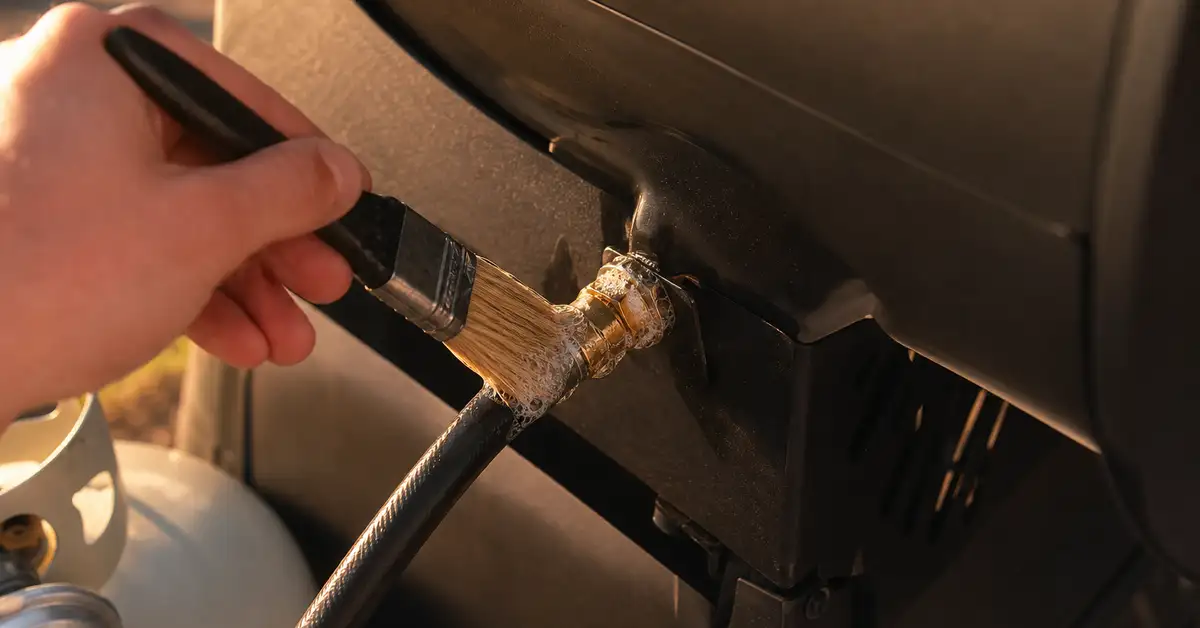
Check for leaks with soapy water, never a flame. Mix dish soap and water, brush it on hose connections and the regulator, and turn on the gas (grill off) — bubbles mean a leak. Never check for a gas leak by holding a lighter or match near a connection.
Handle cylinders upright. Transport and store propane cylinders standing up, and never store a spare cylinder indoors, in a vehicle interior, or near a heat source.
Respect clearance distances. Follow the manufacturer’s minimum clearance from walls, eaves, railings and siding — a small grill still throws real heat close to a combustible surface.
Watch for grease fires. Keep the grease tray or drip pan emptied and never leave a lit grill unattended, even a small one.
Never DIY a natural gas conversion. Only use a natural gas grill built for it from the factory, or a manufacturer-approved conversion kit installed to spec — a mismatched regulator or orifice on an unapproved conversion is a genuine fire risk and voids the warranty.
Food safety matters here too: cook to USDA-safe internal temperatures and use a reliable instant-read meat thermometer rather than guessing by eye, especially on a smaller grill where hot spots are more pronounced.
Related guides
Considering pellet instead of propane? See our guide to the best small & portable pellet grills. Want a bigger appliance for the backyard? See our full range in best pellet grill & smoker combos. Keep your new grill running well with how to clean a grill and protect it with one of our best grill covers. Want real wood smoke out of this grill? See our best smoker boxes guide. New grates, or breaking in a brand-new grill? See our how to season a grill guide before your first cook. Rounding out the kit, check our best instant-read meat thermometers. Already sold on propane? Our best vertical & propane smokers guide covers the low-and-slow side of the same fuel. Buying around the holidays? See our Black Friday grill & smoker deals guide before you spend. Not sure gas is even the right fuel for your space? Our fuel decision guide for small spaces compares charcoal, gas and pellet honestly. Want a full-size cart grill instead of something portable? See our best gas grills for the money guide.
Frequently asked questions
What’s the best small gas grill for an apartment balcony?
Check your lease and local fire code first — many apartments and condos restrict or ban propane grills on balconies entirely, regardless of size. Where it’s genuinely permitted, the Cuisinart CGG-180 is the smallest, most storage-friendly option here at 150 sq in with an integrated fold-up stand, but confirm the rules before buying rather than after.
How long does a 1 lb propane cylinder last on a portable grill?
Roughly 2–2.5 hours of continuous high-heat cooking on a single 8,500–9,500 BTU burner, and well under an hour on a three-burner grill running 20,000 BTU on high. Most cooks use less than full power most of the time, so real-world duration is usually longer — but pack a spare 1 lb cylinder or an adapter hose to a 20 lb tank for anything longer than a single cookout.
Should I buy a propane or natural gas portable grill?
If your patio or deck has a plumbed natural gas line, a factory-built natural gas model like the Napoleon TravelQ PRO285N removes the hassle of propane tanks entirely. If you plan to camp, tailgate, or move the grill around, propane is the more flexible fuel — cylinders are cheap, universally available, and don’t tie you to a fixed gas line. Never convert an LP-only grill to natural gas without a manufacturer-approved kit.
Is a small gas grill powerful enough to sear a steak?
Yes — BTU density matters more than total BTU. A concentrated single burner like the Weber Q1200’s 8,500 BTU over 189 sq in sears just as effectively as a much bigger multi-burner grill, because the heat is focused rather than spread thin. Look for a well-built cast-iron or stainless grate that holds heat, not just a high BTU figure on the box.
What’s the difference between a tabletop grill and a stand-up portable grill?
A tabletop grill (like the Cuisinart CGG-180 or CGG-306) has no legs or stand of its own — you set it on a table, tailgate or counter. A stand-up portable (like the Weber Traveler or Coleman RoadTrip 285) includes its own folding or wheeled base, so it works on grass, gravel or anywhere without a table nearby, at the cost of a bulkier folded footprint.
Can I run a portable gas grill off a full-size 20 lb propane tank?
Several grills in this guide, including the Weber Q1200 and Weber Traveler, explicitly support an adapter hose that connects to a standard 20 lb cylinder instead of 1 lb disposables — a much cheaper and longer-lasting option if you’ll be grilling more than occasionally. Check the manufacturer’s accessory list for the correct adapter hose for your specific model.
How much cooking area do I actually need?
A rough rule of thumb is about 100 square inches per person you regularly cook for. That puts the 150–200 sq in tabletop grills in this guide at a comfortable 2–4 person capacity, and the 285–320 sq in stand-up portables at 4–6 people — enough for a genuine tailgate or camping group without stepping up to a full-size cart grill.
Are any of these gas grills subject to a safety recall?
We screened every pick in this guide against the CPSC recall database, and none of the 8 products above is currently subject to an active recall. Two 2026 recalls are worth knowing about but don’t apply here: the Conair/Cuisinart Propel+ Four Burner 3-in-1 Gas Grill (model CGG-6331) was recalled for a shattering pizza-oven glass window — a completely different, larger multi-function grill from the CGG-180 and CGG-306 featured here, neither of which has a pizza-oven glass window. Separately, three 2026 CPSC recalls cover metal wire-bristle grill brushes (an accessory, not a grill) — Weber (February), Nexgrill (March) and Cuisinart (July, expanded in August to cover all Cuisinart-brand wire-bristle brushes), about 17 million brushes in total — over an ingestion hazard; if you own an older wire brush from any of these brands, check it against the recall and switch to a bristle-free brush or scraper. Always confirm current recall status directly at cpsc.gov before buying, especially secondhand.
How we choose
We don’t run a testing lab, and we never fake “as tested.” For this guide we combined manufacturer specifications with reputable outdoor-living editorial (Serious Eats, Food & Wine, OutdoorGearLab, Wirecutter) and independently re-verified every pick’s current availability and specs directly against the manufacturer — one candidate (the older Weber Q2200) turned out to have been quietly superseded by the current Q2800N+, so we swapped to the model actually being sold today rather than carry over a stale spec sheet. We screened every pick against the U.S. Consumer Product Safety Commission’s recall database before publishing. We use qualitative price bands rather than prices that go stale. Read more on the How We Choose page.
Sources
Manufacturer product pages: Weber (Q 1200, Q 2800N+, Traveler), Char-Broil (Grill2Go X200), Coleman (RoadTrip 285), Cuisinart (CGG-180, CGG-306), Napoleon (TravelQ PRO285N). Editorial and specialist coverage: Serious Eats, Food & Wine, OutdoorGearLab, Wirecutter (NYT), Consumer Reports, The Barbecue Lab, Smoked BBQ Source. Fuel and safety guidance: U-Haul (propane BTU/burn-time reference), JustAnswer (natural gas conversion guidance). Safety and recall screening: U.S. Consumer Product Safety Commission (CPSC.gov). Details were current at the time of research (2026); confirm specifications and current availability with the manufacturer before buying.