A small or portable pellet grill is a wood-pellet-fueled cooker built for a tight footprint or genuine travel — a tabletop unit with a latching lid, a folding-leg tailgate grill, or a compact patio smoker — rather than a full-size backyard pit. It still uses an auger, fan and digital controller to hold steady wood-fired heat; it’s just sized (and often powered) to go where a 700-square-inch grill can’t.
That’s exactly why “best small pellet grill” is its own search — tailgaters, campers, RV owners and small-patio or balcony cooks don’t want a scaled-down version of a full-size list, they want honest answers about what actually fits. We’re a research-led site, not a testing lab, so this guide pulls manufacturer specifications and reputable coverage (SmokedBBQSource, AmazingRibs, HeyGrillHey) to rank 8 genuinely compact or portable pellet grills for 2026, with the trade-offs named plainly. Here’s how we choose.
Our top picks at a glance
- Best overall tabletop: Traeger Ranger
- Best value: Pit Boss Navigator 150
- Most cooking area in a portable: Camp Chef Pursuit 20
- Best 12V / vehicle-powered: Green Mountain Grills Trek Prime 2.0
- Best battery-powered (truly cordless): Pit Boss Portable Battery-Powered Grill
- Best for a small group: Traeger Tailgater
- Best budget small-patio: recteq RT-B380 Bullseye
- Best premium small-patio / highest heat: recteq RT-B380X Bullseye Deluxe
Our inclusion rule — what actually counts as “small” or “portable”
We held every pick to one standard: a primary cooking area of roughly 450 sq in or less, or a genuinely portable unit with carry handles, folding legs or a lid latch and a manufacturer-stated weight we can name. A few full-size grills market themselves as “compact” — we didn’t include them. Everything below either tucks under a tabletop, folds up for the truck bed, or is small enough to live on a modest patio without dominating it.
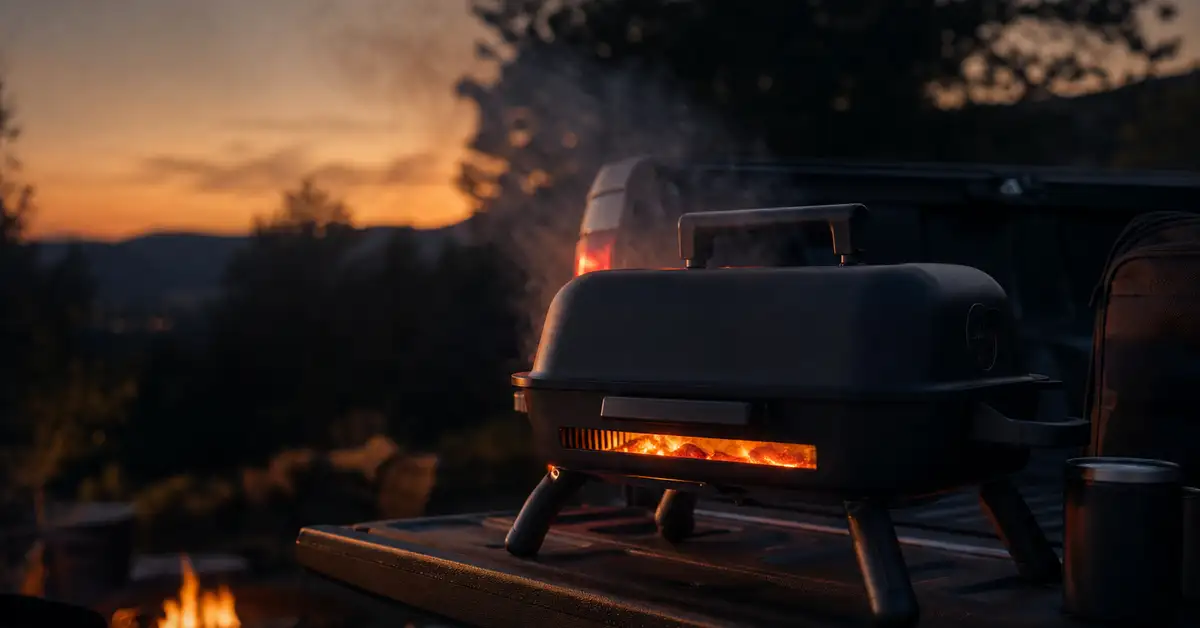
How small is small? Cooking-area classes, in real numbers
Manufacturer marketing throws around “compact” and “portable” pretty loosely, so here’s how the category actually breaks down by primary cooking area:
- Tabletop / true portable: ~175–300 sq in. Latching lids, carry handles, 60–65 lb bodies built to ride in a trunk or truck bed. Feeds 2–5 people comfortably.
- Small-patio: ~300–450 sq in. Compact enough for a modest deck or patio, usually without folding legs, but still a genuine step down from a full-size pit.
- Full-size: 450+ sq in, commonly 700–1,400+ sq in. Multi-rack backyard cookers — see our Best Pellet Grill & Smoker Combos guide for that range.
One pick below (the Camp Chef Pursuit 20, at 501 sq in) sits just over our 450 sq in line on paper — we kept it in because its folding-leg, travel-ready design and manufacturer weight rating make it unmistakably a portable grill, just the largest one in this guide. Everything else here is 380 sq in or smaller.
What actually matters when you’re choosing a small pellet grill
Footprint, weight and how it packs down. A latching lid and folding or removable legs matter more than a few extra square inches if you’re actually loading this into a vehicle every time. Check the folded dimensions, not just the open ones.
Power source. Most tabletop and small-patio pellet grills run on standard 120V household power — fine for a driveway, powered campsite or patio outlet, but you’ll need an inverter or generator for true off-grid use. A handful of models are built around 12V (vehicle/battery) power or an internal battery instead, which changes where you can actually use them.
Hopper size vs. cook length. Small hoppers (5–10 lb) mean more refills on a long cook. That’s a fair trade for portability, but it’s worth knowing before you plan an all-day brisket in a tailgate lot.
Direct-flame searing. Several small grills now offer a flame-broiler lever or an open-flame “high-heat” mode that pushes well past standard pellet-grill temperatures — useful if you want real sear marks, not just low-and-slow.
The 8 best small and portable pellet grills for 2026
Ranked in the order we’d recommend them for most buyers — but every pick names exactly who it’s for, so jump to the one that matches your space, power situation and budget.
Transparency first: This guide contains affiliate links. If we’re enrolled in an affiliate program, we may earn a commission at no extra cost to you — it never affects how we research or rank. Read our full affiliate disclosure policy.
1. Traeger Ranger
What it is: Traeger’s compact tabletop pellet grill — a scaled-down version of its full-size grills with the same digital set-and-forget control.
Best for: tailgates, camping and small patios where you want real wood-fired flavor without a full-size footprint, from a brand with wide dealer and parts support.
Why we rate it: 176 sq in is enough for several burgers, steaks or a couple of small racks of ribs, and the latching lid and 60 lb body make it genuinely easy to load into a car. It runs on standard 120V power through a straightforward digital controller.
Watch-outs: the 8 lb hopper means more refills on a long cook, and it tops out at 450°F — fine for grilling, not built for hard searing. An earlier generation of Traeger’s portable line (the Scout and Ranger, sold 2018) was recalled by the CPSC over grease leaking from the drip tray and posing a fire risk; Traeger offered a free replacement, repair kit or refund at the time, and current-production units reflect the fix, but it’s still worth staying on top of grease cleanout on any portable pellet grill.
The specs: 176 sq in · up to 450°F · 8 lb hopper · 60 lb · 120V mains · Price band: $300–700
3. Camp Chef Pursuit 20
What it is: a folding-leg portable pellet grill with the largest cooking surface of any genuinely portable model we found.
Best for: bigger tailgates, family camping trips, or anyone who wants portable-grade travel features without giving up much cooking capacity.
Why we rate it: 501 sq in across two racks is more space than several “small-patio” grills, yet it still folds down (legs tuck underneath, push-button release) to 38” × 18.5” × 21” for transport. A 160–500°F range and 10 lb hopper suit both low-and-slow and standard grilling, and Camp Chef backs it with a 3-year warranty.
Watch-outs: at 82 lb it’s the heaviest grill in this guide — genuinely portable, not genuinely light — and there’s no Wi-Fi or app control.
The specs: 501 sq in · 160–500°F · 10 lb hopper · 82 lb, folding legs · 120V mains · 3-yr warranty · Price band: $300–700
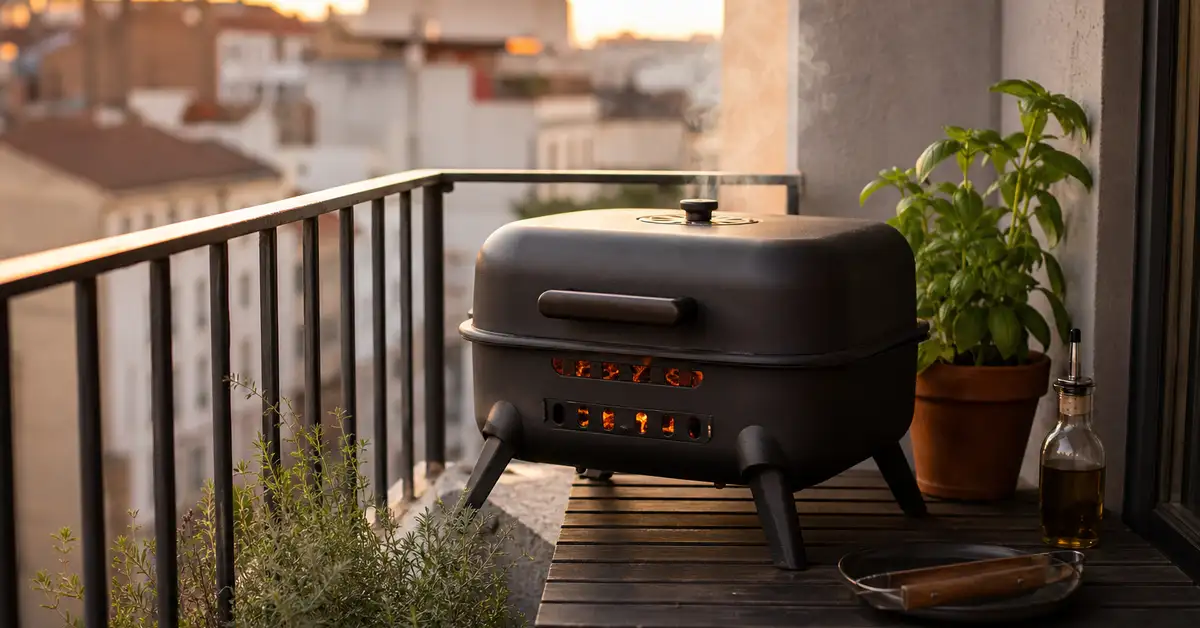
4. Green Mountain Grills Trek Prime 2.0
What it is: GMG’s current small portable pellet grill, built around 12V DC power instead of a standard household plug, with Wi-Fi smart control.
Best for: RV owners, overlanders and serious tailgaters who want to run a pellet grill directly from a vehicle battery or RV electrical system, not just off a wall outlet.
Why we rate it: GMG’s own spec sheet lists a 219 sq in cooking area, a 9 lb hopper and a 150–550°F range at 63 lb, with a Wi-Fi smart controller and digital display you can monitor from GMG’s app. The 12V architecture (with a dedicated long power cord) is the real differentiator — it can run from a vehicle’s 12V system rather than needing an inverter or generator. GMG backs it with a 3-year warranty.
Watch-outs: some retailers list a larger cooking area (up to ~274 sq in) with an optional second shelf — we’ve used GMG’s own base-unit figure. Running off a vehicle battery for a full day works best with a deep-cycle auxiliary battery or the engine running intermittently, not a starter battery alone.
The specs: 219 sq in · 150–550°F · 9 lb hopper · 63 lb · 12V DC, Wi-Fi · 3-yr warranty · Price band: $300–700
5. Pit Boss Portable Battery-Powered Wood Pellet Grill
What it is: a cordless pellet grill that runs on an internal battery instead of a 120V plug or a vehicle hookup — genuinely usable with no power source nearby at all.
Best for: campsites, beaches and tailgate lots with no outlet and no vehicle parked next to the grill.
Why we rate it: the same 256 sq in cooking area and 180–500°F range as Pit Boss’s mains-powered Navigator 150, but built around a rechargeable battery rated for up to 15 hours of run time — a genuinely different use case from every other pick here.
Watch-outs: the battery itself carries a shorter 1-year warranty than the rest of the grill, and real-world runtime will vary with temperature and how often the auger and igniter cycle. It’s also priced above the standard mains-powered Navigator 150 for the cordless convenience.
The specs: 256 sq in · 180–500°F · ~5 lb hopper · ~47 lb · rechargeable battery, up to 15 hrs runtime · Price band: $300–700
6. Traeger Tailgater
What it is: the step-up from the Ranger in Traeger’s portable line — same portable body language, more cooking area.
Best for: tailgates and camping trips where you’re feeding four to six people rather than two or three.
Why we rate it: 300 sq in is a meaningful jump over the Ranger’s 176 sq in while the 62 lb weight and portable body stay easy to transport. Same 8 lb hopper, 450°F ceiling and 120V mains power as the Ranger, so the trade-offs are identical — you’re simply paying for more grate space.
Watch-outs: no direct-flame searing and the same hopper-refill reality on longer cooks as its smaller sibling. It shares the Ranger’s design lineage, though the CPSC’s 2018 recall specifically named the Scout and Ranger models, not the Tailgater.
The specs: 300 sq in · up to 450°F · 8 lb hopper · 62 lb · 120V mains · Price band: $300–700
7. recteq RT-B380 Bullseye
What it is: recteq’s standard (non-Wi-Fi) direct-flame Bullseye — a compact, high-heat grill built to live on a small patio rather than travel.
Best for: small-patio cooks who want real searing heat and recteq’s build quality without paying for the Deluxe’s smart-control features.
Why we rate it: 380 sq in in a compact footprint, a PID controller that holds temperature tightly, and a genuinely high ceiling for a grill this size. recteq backs it with a 2-year limited warranty.
Watch-outs: no Wi-Fi or app control, and at around 70 lb it’s built for a fixed spot on a patio rather than frequent loading into a car.
The specs: 380 sq in · 200–750°F · 15 lb hopper · ~70 lb · 120V mains, PID (no Wi-Fi) · 2-yr warranty · Price band: $300–700
8. recteq RT-B380X Bullseye Deluxe
What it is: the smart-control, higher-heat version of the Bullseye — same compact 380 sq in footprint, with dual-band Wi-Fi and an app-connected probe.
Best for: small-patio cooks who want the most heat and the most control this size of grill offers.
Why we rate it: an 18 lb hopper (more than double the standard Bullseye’s), a PID controller rated to hold within 25°F of the set point, and a maximum temperature up to 1,000°F for genuine steakhouse searing — all in the same compact footprint as recteq’s base model. Backed by a 2-year limited warranty.
Watch-outs: it’s the priciest grill in this guide and, at around 88 lb, the heaviest of the small-patio picks — a compact backyard grill, not a travel grill. Like the standard Bullseye, it runs on mains power only.
The specs: 380 sq in · 200–1,000°F · 18 lb hopper · ~88 lb · 120V mains, PID + Wi-Fi · 2-yr warranty · Price band: $700–1,500
Small pellet grills compared
Prices move constantly, so we show price bands on our ladder (under $50 · $50–150 · $150–300 · $300–700 · $700–1,500 · $1,500+) rather than figures that go stale — tap through to check the current price yourself.
| Model | Best for | Cook area | Weight | Power | Price |
|---|---|---|---|---|---|
| Traeger Ranger | Overall tabletop | 176 sq in | 60 lb | 120V | $300–700 |
| Pit Boss Navigator 150 | Value | 256 sq in | 43.4 lb | 120V | $150–300 |
| Camp Chef Pursuit 20 | Most cook area | 501 sq in | 82 lb | 120V | $300–700 |
| GMG Trek Prime 2.0 | 12V / vehicle power | 219 sq in | 63 lb | 12V DC | $300–700 |
| Pit Boss Battery-Powered | Battery / cordless | 256 sq in | ~47 lb | Battery | $300–700 |
| Traeger Tailgater | Small group | 300 sq in | 62 lb | 120V | $300–700 |
| recteq RT-B380 Bullseye | Budget small-patio | 380 sq in | ~70 lb | 120V | $300–700 |
| recteq RT-B380X Deluxe | Premium small-patio | 380 sq in | ~88 lb | 120V | $700–1,500 |
Specs are drawn from manufacturer materials and reputable editorial sources; always confirm current details with the manufacturer before buying.
Frequently asked questions
Can you use a small pellet grill on an apartment balcony or condo patio?
Don’t assume yes just because it’s electric. A pellet grill still burns solid wood fuel and vents hot exhaust, so many leases, HOA rules and local fire codes treat it the same as a charcoal or gas grill — frequently restricted on balconies or within a set distance of exterior walls. Check your lease or HOA documents and ask building management directly before buying one for balcony use; never run any fuel-burning grill in an enclosed or unventilated space, which risks carbon monoxide buildup.
Do portable pellet grills need mains power, or can they run off-grid?
Most small pellet grills — the Traeger Ranger and Tailgater, Pit Boss Navigator 150, Camp Chef Pursuit 20, and both recteq Bullseye models in this guide — plug into standard 120V household power, so off-grid use needs an inverter or generator. Green Mountain Grills’ Trek Prime 2.0 is built around 12V DC power and can run directly from a vehicle battery or RV electrical system. Pit Boss’s Portable Battery-Powered grill goes further still, running on an internal rechargeable battery with no outlet or vehicle needed at all.
How long can a 12V or battery-powered pellet grill run before it needs power?
It depends on the model and how it’s powered. Pit Boss rates its battery-powered grill for up to 15 hours of run time on a charge. For 12V vehicle-powered grills like GMG’s Trek, the igniter draws the most power during startup (roughly 200–400 watts for the first 10–15 minutes), then settles to a much lower draw for the auger, fan and controller. A starter battery alone isn’t ideal for a long cook; RV owners and serious tailgaters typically use a deep-cycle auxiliary battery or run the engine intermittently to keep up with demand.
Is a small pellet grill worth it, or should I just buy a full-size one?
It depends on what you actually need. If you’re cooking for a crowd at home regularly, a full-size grill (see our pellet grill & smoker combo guide) will serve you better and cost less per square inch of cooking area. A small or portable pellet grill earns its keep when the alternative is not bringing a pellet grill at all — tailgates, campsites, small patios, balconies (where permitted) and RV trips where a 700-square-inch pit simply won’t fit or travel.
What’s the difference between the two recteq Bullseye models?
Both share the same compact 380 sq in cooking area and direct-flame design, but the standard RT-B380 Bullseye uses a simpler PID controller with no Wi-Fi and a smaller 15 lb hopper, topping out around 750°F. The RT-B380X Bullseye Deluxe adds dual-band Wi-Fi, an app-connected probe, an 18 lb hopper and a higher maximum temperature up to 1,000°F — at a meaningfully higher price.
Are there any recalls to know about on small pellet grills?
Yes, one worth naming directly: in 2018 the CPSC recalled Traeger’s Scout and Ranger portable grills (sold 2018) over grease leaking from the drip tray and posing a fire hazard, offering owners a free replacement grill, a replacement drip tray, or a refund. Current-production Ranger units reflect the fix, and the recall didn’t cover the Tailgater. As of our 2026 research we found no active CPSC recall on the Pit Boss, Camp Chef, GMG or recteq models in this guide — separately, metal wire-bristle grill brushes (a cleaning accessory, not a grill) have seen multiple 2026 recalls across several brands over ingestion risk, so consider a non-wire grill brush regardless of which grill you buy. Always check current recall status with the manufacturer and CPSC before buying.
What internal temperatures should I cook to on a small pellet grill?
The same USDA-consistent targets as any grill: poultry to 165°F; ground meats to 160°F; whole cuts of beef, pork, veal and lamb to at least 145°F with a 3-minute rest; fish to 145°F. Small hoppers and lighter insulation can mean more temperature swing on a portable grill than a full-size one, so lean on a good instant-read thermometer rather than trusting a small grill’s built-in probe alone.
Do small pellet grills need any special safety precautions?
The same fire and food-safety basics as any pellet grill, with less margin for error given the smaller firepot: keep the grease tray and firepot clear of buildup, never run it in a garage, tent or enclosed porch, and let the full shutdown cycle finish before covering or storing it. If you smell smoke from the hopper itself (a “backburn”), follow the manufacturer’s guidance and keep the lid closed rather than opening it. For balcony or patio use, respect the clearance distances from walls and railings in the manufacturer’s manual.
Related guides
Want more cooking area? See our full-size Best Pellet Grill & Smoker Combos guide, or if you’re still deciding between fuel types for a first smoker, compare options in Best Smokers for Beginners. Not sure how to actually run one once you’ve bought it? Our how to use a pellet grill guide covers your first cook, start to finish. Stock up on the best wood pellets for smoking, don’t cook without a good instant-read meat thermometer, and keep any of these covered between trips with a properly fitted grill cover. Shopping around the holidays? See our Black Friday pellet grill deals guide. Still weighing charcoal or gas against pellet for your space? Our fuel decision guide for small spaces lays out the honest trade-offs.
How we choose
We don’t run a testing lab, and we never fake “as tested.” For this guide we combined manufacturer specifications, reputable editorial coverage and a live CPSC recall screen on every model, then held everything to one honest inclusion rule for size and portability rather than stretching the definition to pad the list. We favor plain trade-offs over hype: qualitative price bands instead of prices that go stale, and a clear statement of who each grill is really for. Read more on our How We Choose page.
Sources
Manufacturer specifications: Traeger (Ranger, Tailgater), Pit Boss (Navigator 150 / PB150PPS, Portable Battery-Powered Wood Pellet Grill / PB150PSB), Camp Chef (Pursuit 20), Green Mountain Grills (Trek Prime 2.0), recteq (RT-B380 Bullseye, RT-B380X Bullseye Deluxe). Editorial and comparative coverage: SmokedBBQSource, AmazingRibs, HeyGrillHey, The Barbecue Lab. Safety and recall data: U.S. Consumer Product Safety Commission (CPSC) recall database. Specifications were current at the time of research (2026) and should be reconfirmed with the manufacturer before purchase.