Grills are simple until something goes wrong — and with propane and charcoal, “wrong” usually means a gas leak, a fire, or carbon monoxide, not just a burnt dinner. This guide covers the parts of grill ownership most buying guides skip: how to check a propane grill for a leak before you light it, how far your grill actually needs to sit from your house, why carbon monoxide makes every grill an outdoors-only tool, how to store and transport a propane tank safely, and exactly what to do if you smell gas. Every claim below is sourced to the U.S. Consumer Product Safety Commission (CPSC), the National Fire Protection Association (NFPA), the CDC, or established propane-industry safety guidance — not asserted from general knowledge.
How to check a propane grill for a gas leak (the soapy-water test)
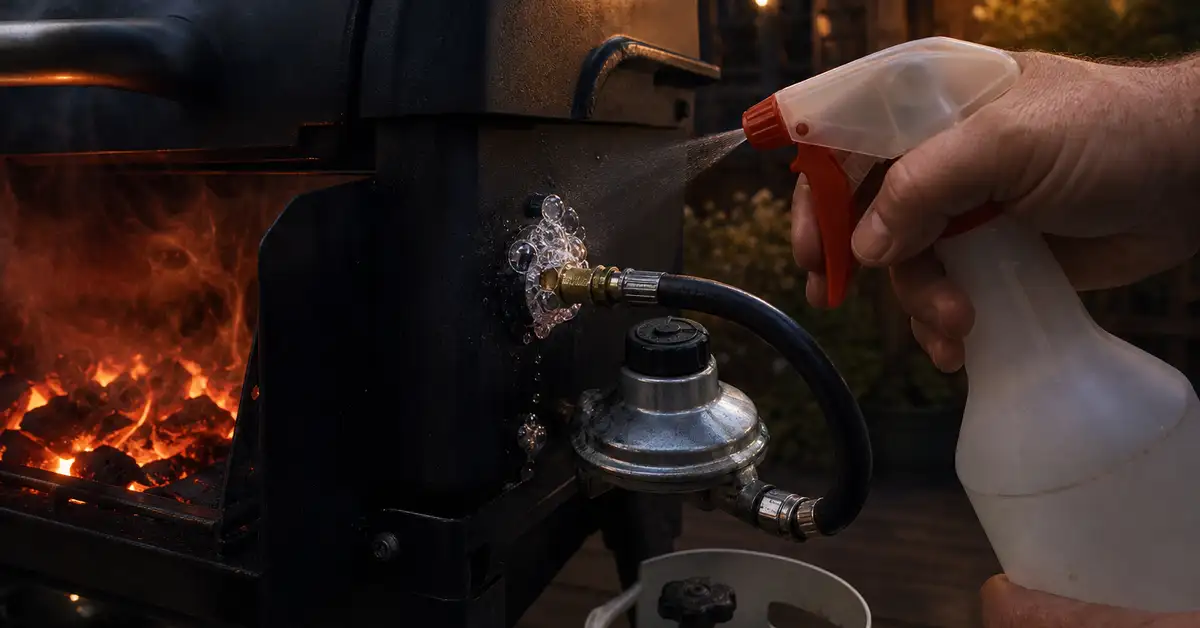
Before the first cook of the season, any time you reconnect a tank, or whenever you replace a hose, CPSC and NFPA both recommend the same simple check — a soapy-water test, never a flame.
- Set up outdoors, away from structures, and confirm every burner control knob is off.
- Mix a soapy solution — liquid dishwashing soap and water. NFPA’s own consumer guidance describes it simply as “a soapy mixture like children’s bubbles.”
- Open the propane cylinder valve fully so the system is pressurized.
- Brush or spray the solution along the entire hose, the regulator, and every connection — the cylinder valve, both hose ends, and the burner manifold.
- Watch for bubbles. Growing, continuous bubbles at any point mean a leak; as a rough rule, smaller bubbles indicate a smaller leak and larger bubbles a bigger one.
- If bubbles form at the tank connection, try tightening it, then retest. If bubbles persist anywhere, or you can’t stop them by tightening, turn the cylinder valve off immediately and don’t light the grill until it’s been inspected and repaired by a qualified propane technician.
Never use a match, lighter, or any open flame to check for a gas leak. Soapy water — or an equivalent non-corrosive leak detector — is the only method CPSC, NFPA and fire-gas codes recognize; NFPA’s own code language is explicit: “never use a match or flame to check for leaks.”
How far does your grill actually need to be from your house?
There are two figures worth knowing here, and we’ll give you both rather than pretend there’s one universal number.
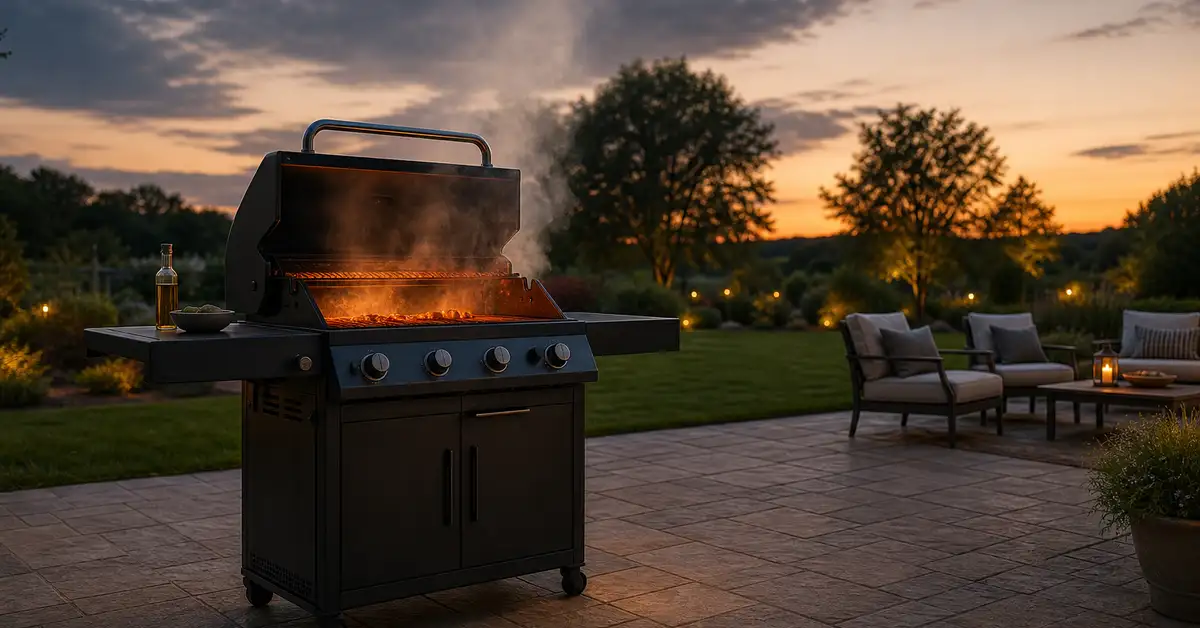
- 3 feet — NFPA’s general consumer safety guidance for a single-family backyard or deck: keep the grill well away from the house, deck railings, eaves and overhanging branches, and maintain at least a 3-foot “safe zone” around it, clear of kids, pets and anything that can burn.
- 10 feet — the stricter figure that shows up in NFPA 1 (the Fire Code) for buildings other than one- and two-family homes: grills generally can’t be used on a balcony, under an overhang, or within 10 feet of any structure. Older CPSC consumer guidance uses the same 10-foot figure for house clearance more generally.
Practical read: 3 feet is the useful day-to-day clearance for a single-family backyard or deck. 10 feet — and often “no balcony use at all” — is the tighter standard that tends to apply in condos, apartments and other multi-family buildings. If you live in a multi-family building, your specific lease, HOA rules and local fire code are what actually govern this, not a single number from the internet — we cover the balcony and fire-code question in more depth in our best grills for small spaces guide.
Carbon monoxide: why every grill is an outdoors-only tool
Any fuel-burning grill — propane, charcoal, or pellet — produces carbon monoxide (CO) as a byproduct of combustion: an odorless, colorless gas that can build up to lethal levels in an enclosed or partly enclosed space. CPSC and the CDC are both blunt about where that makes a grill dangerous: never in a garage, house, basement, tent, camper, or vehicle — even with a door or window open. Both agencies are explicit that opening a door or window is not enough ventilation to prevent a dangerous buildup.
The numbers back up why this warning is so blunt. CPSC estimates roughly 30 deaths and 100 injuries a year in the U.S. from carbon monoxide produced by charcoal grills and hibachis used indoors. Separate CDC data found charcoal grills involved in an estimated 15–27 CO deaths a year, with a comparable toll from grills and camp stoves used inside tents and campers.
If you’ve ever wondered whether a garage, breezeway, carport, or covered patio counts as a safe workaround — it doesn’t. CPSC guidance names all of those specifically as off-limits for grilling. We cover the closely related balcony and enclosed-space fire-code restrictions in more depth in our best grills for small spaces guide, including what many condo and apartment buildings actually permit.
Storing and transporting a propane tank safely
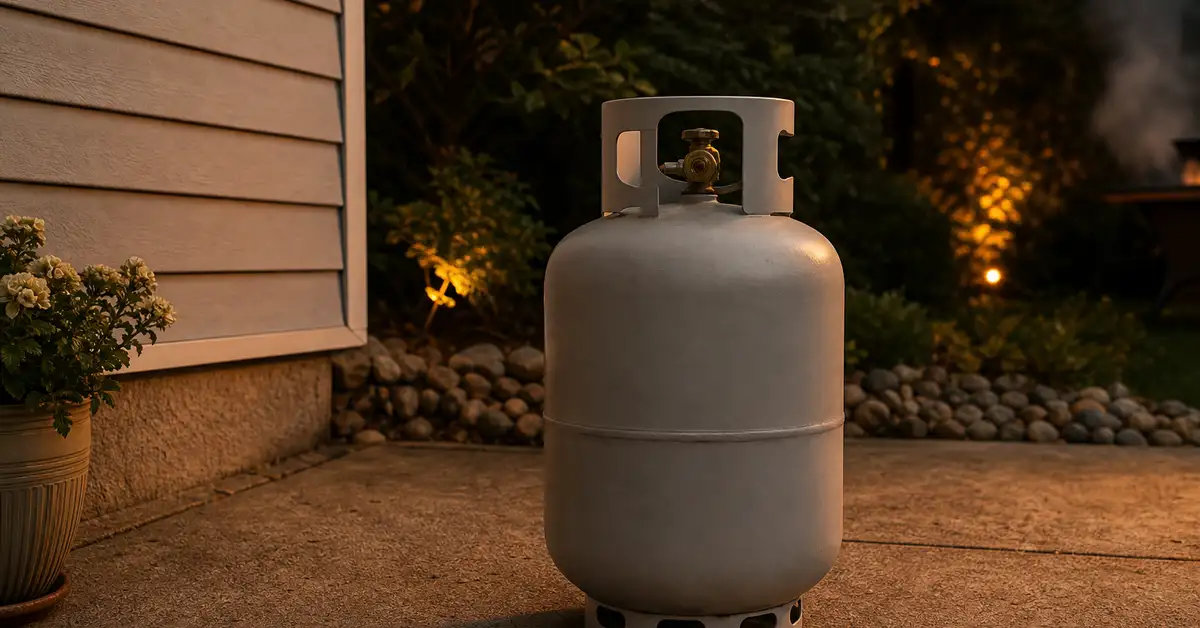
- Keep the cylinder upright — in storage, in use, and while transporting it. Propane cylinders vent through a pressure-relief valve positioned for the vapor space, and that only works correctly right-side up.
- Store it outdoors, in a cool, well-ventilated spot — never indoors, in a garage, or in a basement.
- Don’t store a spare tank under or right next to the grill.
- Keep it away from ignition sources and prolonged direct heat. Never leave a filled cylinder in a hot car or trunk — rising temperature raises the pressure inside the tank.
- When transporting a tank, keep it upright and secured so it can’t tip, roll, or take an impact, ideally in a vehicle’s cargo area rather than the passenger compartment.
If you smell gas or suspect a leak
- Don’t light the grill, strike a match, or create any spark or flame near it.
- Turn all burner controls off.
- If you can reach it safely without walking through gas, close the propane cylinder valve.
- Move away from the grill into open air.
- Call 911 or your propane supplier if the smell persists, you hear hissing, you can’t safely reach the shutoff, or you’re simply not sure it’s safe. CPSC and NFPA both treat any unresolved gas smell as worth reporting, not something to wait out.
- Don’t use the grill again until it’s been inspected and repaired by a qualified technician — don’t attempt the repair yourself.
Frequently asked questions
Can I check for a propane leak with a lighter or match?
No — never use a flame, lighter, or match to check for a gas leak. CPSC and NFPA both specify a soapy-water solution (or an equivalent non-corrosive leak detector) applied to the hose and connections while the gas is on; growing bubbles indicate a leak. Using an open flame to search for leaking propane is itself a serious fire and explosion hazard.
How often should I check my propane grill for leaks?
Check before the first use of each season, and any time you reconnect a tank, replace a hose, or notice a smell of gas. Fire-gas codes also treat every cylinder swap as a natural checkpoint for a leak test.
Is it safe to use a gas grill on a covered patio or under a roof overhang?
Generally no. NFPA 1 (the Fire Code) restricts grill use under overhangs and on balconies for buildings other than one- and two-family homes, and even for a single-family home, keeping the grill clear of eaves and overhangs is standard NFPA consumer guidance. Check your specific building or local fire code before assuming a covered space is fine.
Can carbon monoxide from a grill really be dangerous outdoors?
Used properly outdoors in the open air, a grill’s carbon monoxide disperses and isn’t a meaningful hazard — the real danger is any enclosed or partly enclosed space (garage, tent, camper, breezeway, covered patio treated as a room). CPSC and CDC guidance is specifically about grills used indoors or in enclosed spaces, not open-air backyard use.
Do charcoal grills also produce carbon monoxide, or is that just a propane risk?
Charcoal grills produce CO too — and CPSC’s own data shows charcoal grills and hibachis used indoors are responsible for the majority of grill-related CO deaths it tracks (an estimated 30 deaths and 100 injuries a year). Charcoal keeps producing carbon monoxide until it’s fully extinguished, so a grill with fresh coals shouldn’t be brought indoors or into a garage even after cooking is done.
What should I do if my propane tank runs out mid-cook?
Turn off all burner controls, close the empty cylinder’s valve, and swap in a full tank following the same upright-storage and soapy-water leak-check practice above before you reconnect and relight. Treat the spare tank with the same storage rules (upright, outdoors, away from the grill) while it’s waiting to be used.
Can I store my propane tank in my garage over the off-season?
No. Propane industry and fire-safety guidance is consistent that cylinders should never be stored indoors, in a garage, or in a basement — store the tank outdoors, upright, in a cool and well-ventilated spot, away from the house at the clearance distance covered above.
Is a hissing sound from my grill or tank always a leak?
Treat a hissing sound as an active leak until proven otherwise. Don’t try to light the grill, move away from it, and shut off the cylinder valve if you can reach it safely. If the hissing continues or you can’t safely reach the shutoff, call your propane supplier or the fire department rather than investigating further yourself.
How we choose
We don’t run a testing lab, and we never fake hands-on safety testing we haven’t done. For this guide, every leak-check step, clearance figure and carbon-monoxide warning above was verified against CPSC and NFPA’s own published consumer guidance, CDC clinical guidance, and established propane-industry safety documentation, rather than asserted from general knowledge — the same standard we hold ourselves to on every page that touches food or fire safety. This page doesn’t rank or recommend any product; for grill and smoker picks, see our fuel-specific buying guides elsewhere on the site. Read more on our How We Choose page.
Sources
Leak-check procedure and general grill safety: U.S. Consumer Product Safety Commission (CPSC, “Fire It Up Safely” and “CPSC Releases Grill Safety Tips” consumer releases; CPSC Summer Grilling Safety and Gas Grill fact sheets) and the National Fire Protection Association (NFPA, Grilling Safety Facts & Resources, and NFPA 1/NFPA 58 Liquefied Petroleum Gas Code provisions on leak testing). Clearance distances: NFPA Grilling Safety Facts & Resources and NFPA 1 (Fire Code) provisions on outdoor cooking appliances, and the U.S. Fire Administration (USFA/FEMA) grilling and outdoor-fire safety guidance. Carbon monoxide risk and statistics: CPSC Carbon Monoxide Information Center (Charcoal), CPSC grill safety releases, the CDC’s clinical and emergency guidance on carbon monoxide poisoning, and CDC/ATSDR public health statements on carbon monoxide. Propane tank storage and transport: CPSC gas-grill fact sheets, NFPA fact sheets on placing LP-gas containers, and Propane101.com consumer safety guidance. Details were current at the time of research (2026); always follow your grill manufacturer’s specific instructions and your local fire code, which take precedence over general guidance.