An instant-read meat thermometer is a handheld probe you slide into food for a second or two to check its internal temperature, then remove — the fastest, most reliable way to know a steak is medium-rare, a chicken thigh is safe, or a brisket is genuinely done. Unlike a leave-in probe, it doesn’t stay in the meat during the cook; it’s the spot-check tool you reach for at the moments that matter.
“Best instant read meat thermometer” is one of the most-searched accessory questions in outdoor cooking, and for good reason: it’s the single cheapest upgrade that improves every cook. We’re a research-led site, not a testing lab, so this guide pulls together manufacturer specifications, reputable editorial testing (America’s Test Kitchen, Food Network, The Kitchn) and aggregated owner feedback to rank 12 instant-read thermometers for 2026 from premium to budget — and to be plain about which specs matter and which are marketing. Here’s how we choose.
Our top picks at a glance
- Best overall: ThermoWorks Thermapen ONE
- Fastest premium alternative: Typhur InstaProbe
- Best value from a premium brand: ThermoWorks ThermoPop 2
- Best display: Lavatools Javelin PRO Duo
- Best features for the money: ThermoPro TP622 Lightning
- Best budget: ThermoPro TP19H
- Best budget waterproof: Kizen Instant Read
- Best entry-level: Alpha Grillers Instant Read
- Best simple mid-ranger: ThermoPro TP620
- Best thin tip (fish & burgers): CDN DTQ450X
- Best kitchen-first pick: OXO Good Grips Chef’s Precision
- Best bare-bones budget: Taylor 9842 Waterproof
What matters when you’re choosing
Read speed. The headline spec. The best probes settle in about a second; good mid-rangers take 2–3 seconds; older or thin-tip designs can take 5–6. Speed matters most on thin, fast-moving cuts — a steak over high heat can climb several degrees while a slow thermometer is still thinking. Be a little skeptical of fraction-of-a-second marketing claims: independent testers usually measure the time to a stable reading, which runs slightly longer.
Accuracy. Premium probes claim ±0.5°F and mid-tier models ±0.9–1°F — genuinely useful when you’re threading the needle on medium-rare (130–135°F) or the 165°F poultry line. For barbecue cuts pulled at 195–205°F, ±2°F is honestly fine.
Waterproofing. Look for a real IP rating. IP67 (Thermapen ONE, ThermoPop 2, Typhur, Kizen) survives a dunk in the sink; IP65/IPX6 handles heavy rinsing but not immersion. Meat juice and rain find their way into unsealed housings eventually.
Display. Auto-rotating, backlit displays sound like luxuries until you’re probing a brisket in a dark smoker at 6 a.m. Antifog coatings (Lavatools) earn their keep over steaming pots.
Calibration. Every thermometer drifts eventually. Some offer one-button field calibration (CDN, Taylor, ThermoPro); premium ThermoWorks and Typhur units are factory-calibrated and meant to be verified, not adjusted. Either way, the check is the same — see the ice-bath FAQ below.
Safe internal temperatures (what you’re aiming for)
| Food | USDA safe minimum | Common culinary target |
|---|---|---|
| Poultry (whole & ground) | 165°F | 165–175°F (thighs higher for texture) |
| Ground beef, pork, lamb | 160°F | 160°F |
| Whole cuts of beef, pork, lamb | 145°F + 3-min rest | Steak 130–140°F by preference* |
| Fish & shellfish | 145°F | Salmon often pulled ~125–130°F* |
| Brisket (for tenderness) | 145°F minimum | ~195–205°F — see our brisket guide |
| Pork butt / pulled pork | 145°F minimum | ~195–205°F — see our pork butt guide |
USDA safe minimums per FoodSafety.gov. *Cooking below the USDA minimum (as many cooks do for steak and salmon) is a personal-preference call with a small added risk — the safe minimums are the official guidance. Barbecue cuts like brisket and pork butt are taken far past the minimums for tenderness, not safety. Always probe the thickest part, away from bone and fat.
The 12 best instant-read meat thermometers for 2026
Ranked for a typical US backyard cook, but every entry says who it’s for — jump to the budget and features that fit how you cook.
Transparency first: This guide contains affiliate links. If we’re enrolled in an affiliate program, we may earn a commission at no extra cost to you — it never affects how we research or rank. Read our full affiliate disclosure policy.
1. ThermoWorks Thermapen ONE
What it is: the benchmark instant-read — a folding-probe thermometer with one-second readings that virtually every serious test kitchen lands on.
Best for: anyone who cooks outdoors regularly and wants the reading they can trust every time, for years.
Why we rate it: one-second, ±0.5°F readings across a huge −58–572°F range, a display that auto-rotates and auto-backlights, full IP67 waterproofing and a 5-year warranty. It’s America’s Test Kitchen’s long-standing favorite, and owner sentiment matches the editorial consensus.
Watch-outs: premium price for a single-function tool, and the folding hinge deserves respect — don’t force it.
1-sec read · ±0.5°F · −58–572°F · IP67 · auto-rotating backlit display · 5-yr warranty · $$$
2. Typhur InstaProbe
What it is: the challenger to the Thermapen throne — a premium instant-read with a bright rotating OLED display and sub-second readings.
Best for: tech-minded grillers who want the fastest stable reading available and a display you can read from across the patio.
Why we rate it: independent review testing has clocked readings settling in under a second, backed by a seven-point factory calibration to ±0.5°F, IP67 waterproofing and that superb OLED. It trades punches with the Thermapen ONE spec-for-spec.
Watch-outs: premium price; its low-end range starts higher than rivals (fine for cooking, less good for deep-freeze checks); a younger brand than ThermoWorks.
Sub-second read · ±0.5°F (7-point calibration) · rotating OLED · IP67 · $$$
3. ThermoWorks ThermoPop 2
What it is: ThermoWorks’ everyday thermometer — a compact lollipop-style probe with most of the Thermapen’s trustworthiness at a fraction of the price.
Best for: home cooks who want documented ThermoWorks accuracy without paying flagship money — the common editorial budget pick.
Why we rate it: ThermoWorks specifies 2–3 seconds to within 1°F in a proper ice bath, ±1°F accuracy through the entire cooking range that matters (14–208°F), the same −58–572°F span as the Thermapen, and real IP67 waterproofing.
Watch-outs: a beat slower than the flagship, with simpler ergonomics — the trade you’re making for the price.
2–3 sec read · ±1°F (14–208°F) · −58–572°F · IP67 · backlit display · $$
4. Lavatools Javelin PRO Duo
What it is: the mid-price favorite with the biggest, clearest screen in the category — a 2-inch antifog backlit display readable from any angle.
Best for: anyone who squints at thermometer screens — and steam-heavy cooks (stocks, braises, humid smokers) where lesser displays fog over.
Why we rate it: ±0.9°F specified accuracy in the −4–302°F range, quick 2–3-second readings in most independent coverage, and that huge 360°-viewable display. A frequent editorial “best buy.”
Watch-outs: splash-resistant rather than fully immersion-proof, and its −40–482°F range is a touch narrower than rivals (still plenty for meat).
2–3 sec read · ±0.9°F (−4–302°F) · −40–482°F · 2″ antifog backlit display · splash-resistant · $$
5. ThermoPro TP622 Lightning
What it is: ThermoPro’s flagship instant-read — a one-second thermocouple probe with an ambidextrous rotating backlit display and a magnetic back.
Best for: cooks who want near-premium speed and accuracy plus genuinely useful extras, at a mid-range price.
Why we rate it: a one-second headline read speed with ±0.5°F claimed accuracy, flip-open auto-wake, IP65 water resistance, and a 10-year warranty when you register — the longest coverage in this guide.
Watch-outs: ThermoPro’s fastest marketing claims describe the display refresh more than the full settle time; treat it as a one-second thermometer, which is still excellent. IP65 means heavy rinsing, not dunking.
~1-sec read · ±0.5°F claimed · −58–572°F · IP65 · rotating backlit display · magnetic back · 10-yr registered warranty · $$
6. ThermoPro TP19H
What it is: the budget workhorse — a full-size instant-read with a 4-inch stainless probe and documented specs at an entry-level price.
Best for: grillers who want a real spec sheet (not just “fast and accurate”) for the least money.
Why we rate it: ±0.9°F specified accuracy and the same full −58–572°F range as thermometers costing several times more, plus a backlit display. The price-performance ratio is the story here.
Watch-outs: readings settle in a few seconds rather than one, the housing is splash-resistant rather than sealed, and the feel is plainly budget.
Few-second read · ±0.9°F · −58–572°F · 4″ probe · backlit · splash-resistant · $
7. Kizen Instant Read
What it is: a hugely popular budget folding instant-read whose party trick is a real IP67 waterproof rating at a bargain price.
Best for: the cook who will inevitably leave it out in the rain or drop it in the sink — no judgment.
Why we rate it: 2–3-second readings, a backlit screen, magnetic back, user recalibration and IP67 sealing — a feature set that undercuts mid-tier prices. Kizen’s own calibration guidance (a proper ice bath) matches best practice.
Watch-outs: long-term hinge and sensor durability is more variable than the premium brands — a fair trade at this price.
2–3 sec read · IP67 waterproof · backlit · magnetic back · recalibratable · $
8. Alpha Grillers Instant Read
What it is: one of Amazon’s perennial best-sellers — a simple, fast folding thermometer at a genuinely low price.
Best for: first-timers moving up from poking the meat and guessing, and as a stocking-stuffer for the griller in your life.
Why we rate it: the manufacturer claims 1–2-second readings, the backlit display is clear, and the sheer volume of satisfied owners says it does the everyday job well.
Watch-outs: water-resistant rather than rated waterproof, and published spec detail is thinner than ThermoPro’s — confirm current specs with the manufacturer.
1–2 sec claimed read · backlit · water-resistant · $ (confirm specs with the manufacturer)
9. ThermoPro TP620
What it is: the TP622’s no-frills sibling — the same broad range and rotating display concept with a conventional (still quick) sensor.
Best for: cooks who like ThermoPro’s build and warranty support but don’t need the Lightning’s one-second thermocouple.
Why we rate it: a long 4.3-inch 304-stainless probe that reaches the center of thick roasts, a 180° rotating display, IP65 water resistance and the full −58–572°F range — solid mid-range fundamentals.
Watch-outs: readings take a couple of seconds, and it’s worth stretching to the TP622 if speed is your priority.
Couple-second read · −58–572°F · 4.3″ probe · 180° rotating display · IP65 · $
10. CDN DTQ450X ProAccurate
What it is: a professional-kitchen staple with an ultra-thin 1.5 mm tip that slips into delicate food without tearing it.
Best for: fish fillets, burgers, shrimp and thin chops — anywhere a fat probe leaves a visible hole or drags juice out.
Why we rate it: the thin tip is genuinely better for delicate proteins, IPX6 sealing shrugs off heavy rinsing, and one-button field calibration makes it easy to keep honest for years.
Watch-outs: the 6-second response is the slowest here, and ±2°F accuracy is looser than the leaders — fine for doneness, less ideal for edge-of-window steak calls.
6-sec read · ±2°F · −40–450°F · 1.5 mm thin tip · IPX6 · one-button calibration · $$
11. OXO Good Grips Chef’s Precision
What it is: the trusted kitchenware brand’s take on the instant-read — comfortable, simple, with big easy-to-read numerals.
Best for: cooks whose thermometer lives in the kitchen drawer and visits the grill occasionally.
Why we rate it: classic OXO ergonomics, a clear large-digit display in °F or °C, and wide retail availability with strong brand support behind it.
Watch-outs: the −22–302°F range is the narrowest here (no high-heat oil or sugar work), and it’s not built for outdoor soakings — confirm current specs with the manufacturer.
Large-digit display · −22–302°F · °F/°C · $$ (confirm specs with the manufacturer)
12. Taylor 9842 Waterproof Instant Read
What it is: a commercial-kitchen-style pocket thermometer from one of the oldest names in temperature measurement.
Best for: a glovebox, camping box or backup drawer — a branded, recalibratable thermometer for pocket change.
Why we rate it: waterproof housing, a −40–450°F range, user recalibration and NSF certification — the same basic tool pro kitchens buy by the dozen.
Watch-outs: a small display with no backlight, slower response than the folding designs, and none of the modern conveniences — that’s the point.
Pocket-style · −40–450°F · waterproof · recalibratable · NSF-certified · $
An instant-read is the spot-check half of the thermometer story — for long smokes, pair it with one of the best wireless meat thermometers, and browse the rest of our accessories & consumables guides for the gear that earns its keep. It’s just as handy for checking toppings and thin cuts when you’re breaking in one of the best outdoor pizza ovens, too.
Frequently asked questions
What’s the difference between an instant-read and a leave-in thermometer?
An instant-read is a handheld probe you insert for a second or two to spot-check temperature, then remove — it should never stay in the meat during cooking. A leave-in (wired or wireless) probe stays in the food for the whole cook and reports continuously. Most serious cooks use both: a leave-in probe to manage a long smoke, and an instant-read to verify the true coldest spot before serving.
How fast does an instant-read thermometer really need to be?
For most cooking, 2–3 seconds is plenty. One-second premium probes earn their keep on thin, fast-moving cuts (steaks, burgers, fish) and when you’re probing many spots in a brisket with the smoker lid open. Be skeptical of fraction-of-a-second claims — independent testers measure time to a stable reading, which is usually a bit longer than the marketing number.
How do I check and calibrate my thermometer?
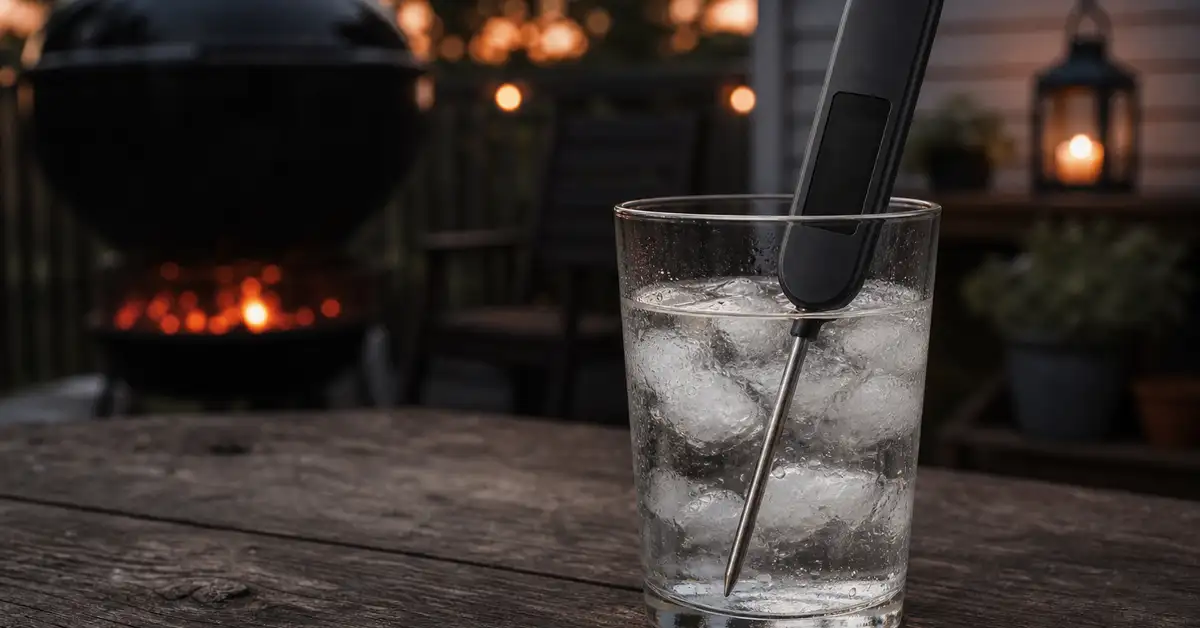
Use an ice bath: fill a glass to the top with crushed ice, add cold water to just below the ice line, wait a minute, then stir the probe tip through the center of the slurry without touching the glass. It should read 32°F (± the manufacturer’s stated accuracy). If your model has field calibration (CDN, Taylor, ThermoPro, Kizen), adjust it there; factory-calibrated units like the Thermapen should simply be verified. A boiling-water check (212°F at sea level, lower at altitude) confirms the top of the range.
What internal temperatures should I cook to?
USDA safe minimums: poultry 165°F; ground meats 160°F; whole cuts of beef, pork and lamb 145°F with a 3-minute rest; fish 145°F. Barbecue cuts are taken well past those minimums for tenderness — brisket and pork butt are typically pulled around 195–205°F. See our brisket and pork butt guides for the full temperature walkthroughs.
Can I leave an instant-read thermometer in the meat while it cooks?
No. Instant-read housings and displays aren’t built for sustained oven or smoker heat — the electronics sit right at the probe, unlike leave-in designs that run a heat-rated cable to an external unit. Probe, read, remove. If you want continuous monitoring, that’s a leave-in probe’s job.
Are instant-read thermometers waterproof?
Check the IP rating rather than the word “waterproof.” IP67 (Thermapen ONE, ThermoPop 2, Typhur InstaProbe, Kizen) survives brief immersion — a sink dunk or heavy rain. IP65/IPX6 (ThermoPro TP622/TP620, CDN) handles rinsing under a tap but not submersion. Unrated budget models should only be wiped clean. Either way, don’t put any of them in the dishwasher unless the manufacturer explicitly says so.
Is a premium thermometer really worth it over a budget one?
Honestly: a good budget probe (ThermoPro TP19H, Kizen) gets you most of the way there for everyday grilling. What the premium tier buys is speed (one second vs a few), tighter accuracy near tricky targets like medium-rare, sealed waterproof housings that survive years of outdoor use, and long warranties. If you cook outdoors most weeks, the upgrade pays for itself in not replacing cheap ones.
Have any instant-read thermometers been recalled?
Our October 2026 search of the US CPSC recall database found no recall for any instant-read thermometer recommended above. (The only notable thermometer recall on record is a 2014 iDevices recall of leave-in temperature probes — a different product category.) The practical safety issues are cleaning the probe between raw and cooked meat, and replacing leaking batteries promptly.
How we choose
We don’t run a testing lab, and we never fake “as tested.” For this guide we combined manufacturer specifications (read speed, accuracy tolerances, temperature range, IP ratings, warranties), reputable editorial testing from America’s Test Kitchen, Food Network and The Kitchn — whose long-running consensus around the Thermapen line we weighed heavily — and aggregated owner-review patterns, with particular attention to the gap between marketing speed claims and independently measured settle times. Every model was checked for existence and current availability and safety screened against the U.S. Consumer Product Safety Commission (CPSC) recall database (October 2026 search; no recall found for any recommended instant-read thermometer). We use qualitative price bands rather than prices that go stale. Read more on the How We Choose page.
Sources
Manufacturer product and support pages: ThermoWorks (Thermapen ONE, ThermoPop 2, ice-bath calibration guide), Typhur (InstaProbe), Lavatools (Javelin PRO), ThermoPro/TempPro (TP622 Lightning, TP620, TP19H), Kizen, Alpha Grillers, OXO (Chef’s Precision), CDN (DTQ450X), Taylor (9842). Retailer listings: Best Buy (Typhur InstaProbe), The Home Depot (ThermoPro TP622W). Editorial coverage: America’s Test Kitchen, Food Network, The Kitchn, Taste of Home, Seared & Smoked. Food-temperature guidance: USDA / FoodSafety.gov. Safety: U.S. Consumer Product Safety Commission (CPSC) recall database (October 2026 search; no recall found for any recommended instant-read thermometer). Details were current at the time of research (2026); confirm specifications with the manufacturer before buying.